
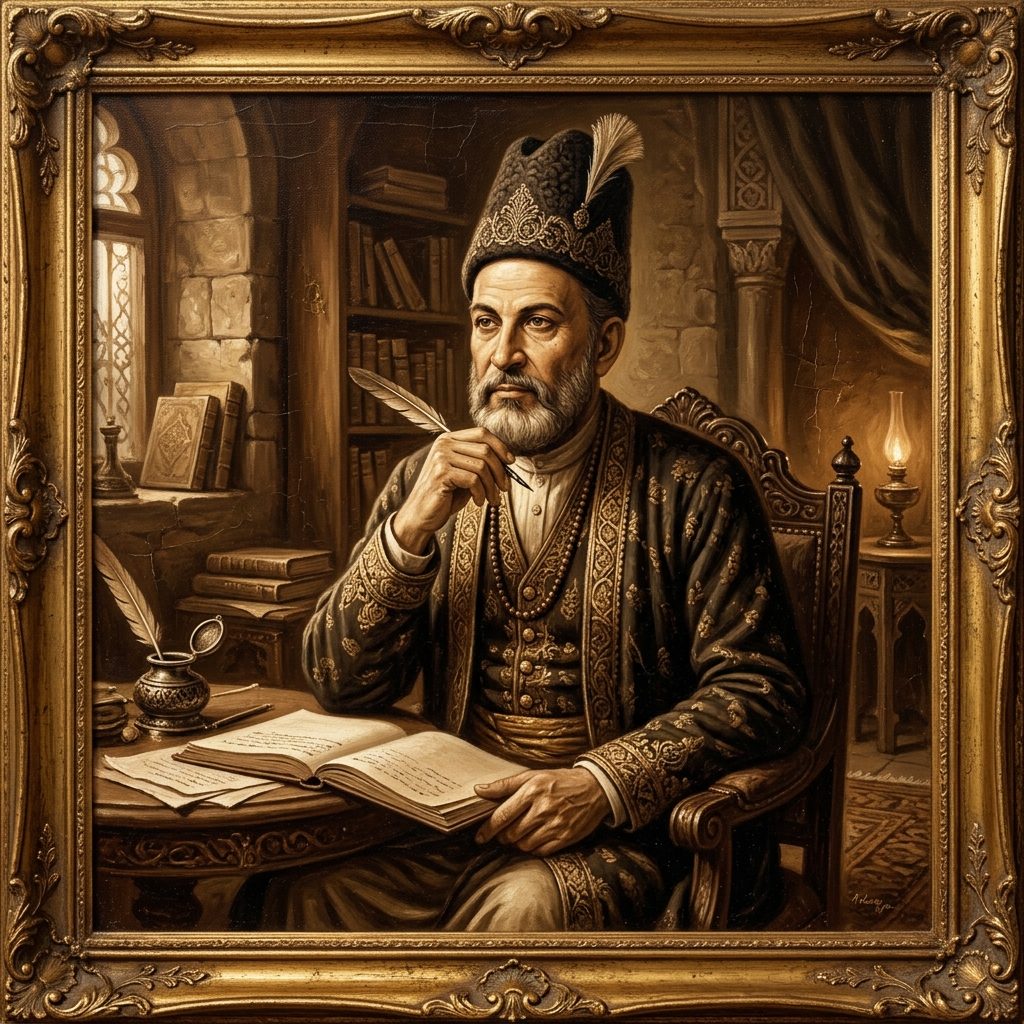
Abdul Ahad Azad
Kashmir's poet of revolution — the river that would not stop. Abdul Ahad Azad (1903–1948), born Abdul Ahad Dar in 1903 at Rangar, a village of Chadoora in the Budgam district of Kashmir, was a Kashmiri poet, historian and literary critic — the first revolutionary poet of Kashmiri literature, and the man who laid the foundations of literary criticism in the language. He was the son of Muhammad Sultan Dar, of the Dar tribe, and learned Persian, Arabic and Islamic philosophy from his father in the village madrassa. In 1918, at sixteen, he became a primary-school teacher, and taught Arabic at Zowhama for thirteen years; in 1925 he passed the Munshi Alim examination of the University of the Punjab with distinction. He wrote his first poem at sixteen. His early verse was love poetry under the pen name Ahad, then poems of nature under Janbaz; in 1935 he took the name Azad — the Free — and met Ghulam Ahmad Mahjoor, who became his mentor and corrected the ghazals he sent him. The verse that made his name is the poetry of revolt: Dariyav, the River, in which the river's onward rush becomes the image of a people breaking its chains; Shikwa-i-Iblis, the Devil's complaint against heaven, seventy-three verses that brought the orthodox down on him; and poems of the poor, the worker and the child. He read Iqbal deeply and took from Marxism its hope of a classless society, and his poems call the youth and the poor to wake, to stand, and to fight. In the 1940s he was close to the progressive strand of Kashmir's national movement; his home was raided, his family harassed, and he was sent to remote postings as punishment — to Tral in 1931, and again in his last years at Surasiyar — and while he was away his four-year-old son died. Beside the poetry he did the work of a historian: his three-volume Kashmiri Zaban aur Shairi, the first history of the Kashmiri language and its poetry from Lalleshwari to his own day, was published after his death, in 1959, 1962 and 1963. He edited the paper Hamdard in its editor's absence and wrote its editorials. Frail all his life, he fell ill at Surasiyar in the spring of 1948; the pain was appendicitis, found too late, and he died in hospital at Srinagar on 4 April 1948, aged forty-five. He was buried at Rangar beside his father's grave, where his memorial calls him the Poet of Revolution and the pioneering literary historian of the Kashmiri language.
Follow Abdul Ahad Azad
0 FollowersReceive instant email alerts whenever new Ghazals, Nazms, or Couplets by Abdul Ahad Azad are published.