
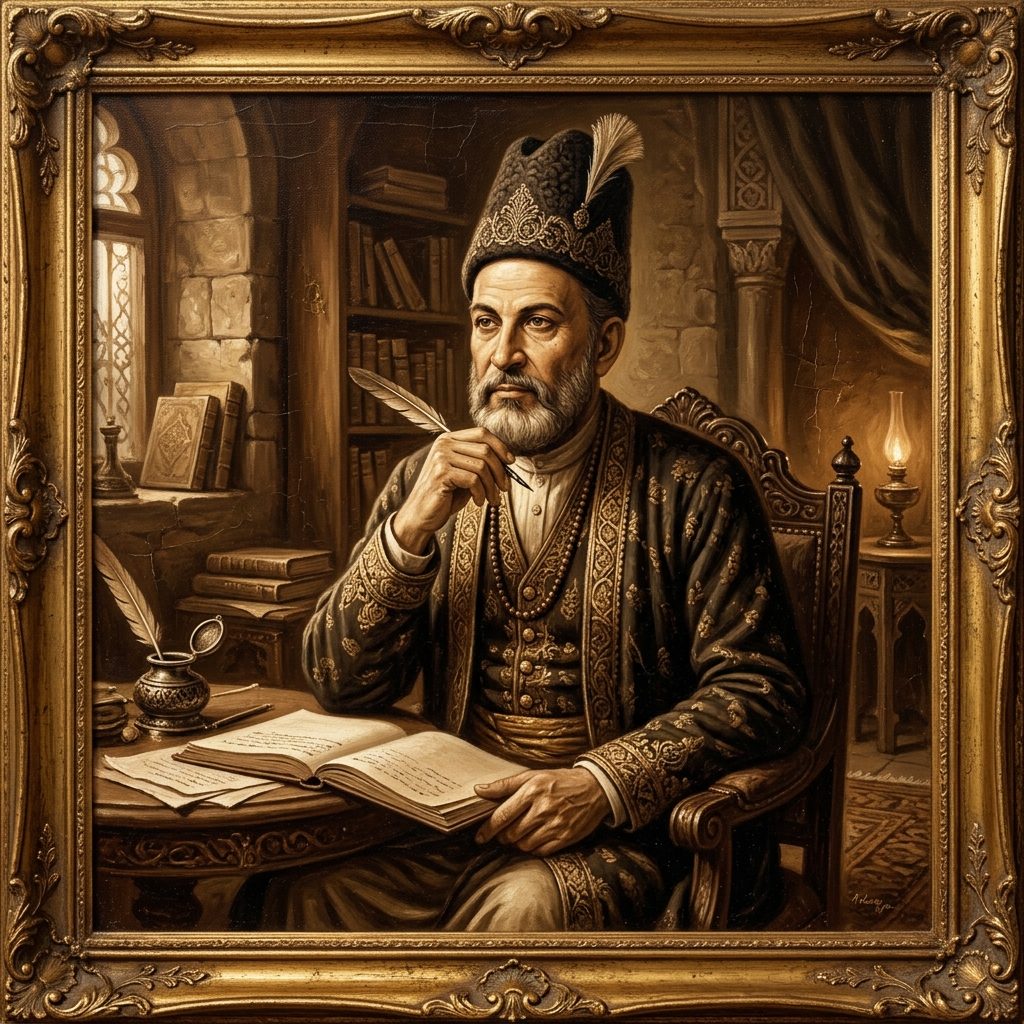
Abdul Rahim Khan-e-Khanan
Akbar's jewel — the general who wrote dohas, and the dohas India still learns by heart. Abdul Rahim Khan-e-Khanan (1556–1627), known to poetry lovers simply as Rahim, was a general, statesman, scholar and poet of Akbar's court — one of the emperor's nine jewels. He was born in Lahore on 17 December 1556, the son of Bairam Khan, Akbar's guardian and regent. When he was four years old his father was murdered in Gujarat, and the boy was brought to Akbar's court, where the emperor raised him, gave him the title of Mirza Khan, and later the highest title of all, Khan-i-Khanan — Khan of Khans. He led armies in Gujarat and the Deccan, governed Ajmer, Gujarat and Khandesh, and tutored Prince Salim, the future Jahangir. Under Jahangir he fell from favour, and his sons died in the troubles of those years. He was a master of many tongues — Persian, Arabic, Sanskrit, Chagatai Turkic — and of the people's speech, Braj Bhasha and Awadhi, in which he wrote the dohas that made him beloved: about three hundred short couplets on love, friendship, charity, humility and the turning of fortune, still learned by schoolchildren across India four centuries later. He translated Babur's memoirs, the Baburnama, from Chagatai into Persian in 1589–90, rendered the Ramayana and Mahabharata into Persian, and wrote two books on astrology in Sanskrit. He built a tomb for his wife Mah Banu in 1598, and was buried beside her there when he died on 1 October 1627. The tomb, restored over six years, was opened to the public in 2020.
Follow Abdul Rahim Khan-e-Khanan
0 FollowersReceive instant email alerts whenever new Ghazals, Nazms, or Couplets by Abdul Rahim Khan-e-Khanan are published.