
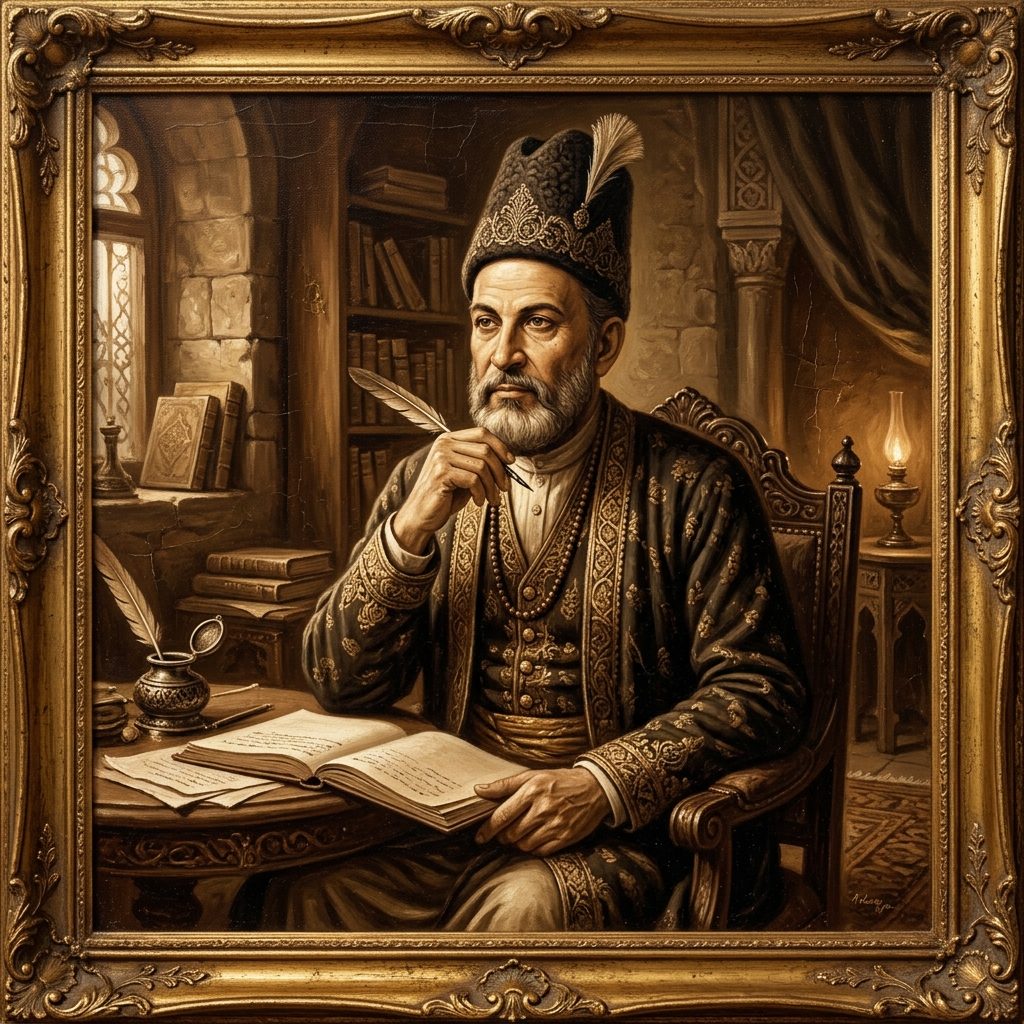
Abul Kalam Azad
Maulana Abul Kalam Azad (1888–1958), scholar, journalist and statesman, was born on 11 November 1888 at Mecca, where his father, the scholar Muhammad Khairuddin, had settled after leaving India in the wake of 1857. The family returned to Calcutta in 1890, and the boy was taught at home by his father, mastering Arabic, Persian and Urdu, and writing from his teens. In 1912, at twenty-three, he founded the Urdu weekly Al-Hilal, whose fearless journalism the British shut down within two years. He rose in the Congress, presiding over it in 1923 and again from 1940 to 1946, and spent years in prison for the freedom struggle, writing the letters from Ahmednagar Fort that became Ghubar-e-Khatir. His great works — the Quranic commentary Tarjuman-ul-Quran, the memoir Tazkira, and the letters — sit beside a small body of early verse, written under the pen-name Azad. When India became free, he became its first Minister of Education, holding the office from 1947 until his death, and laid the foundations of the country's modern learning: the University Grants Commission, the institutes of technology, and the national academies of letters, music, dance and art. He died of a stroke at Delhi on 22 February 1958 and lies buried within the Jama Masjid. His birthday, 11 November, is observed across India as National Education Day, and the Bharat Ratna was conferred on him posthumously in 1992.
Follow Abul Kalam Azad
0 FollowersReceive instant email alerts whenever new Ghazals, Nazms, or Couplets by Abul Kalam Azad are published.