
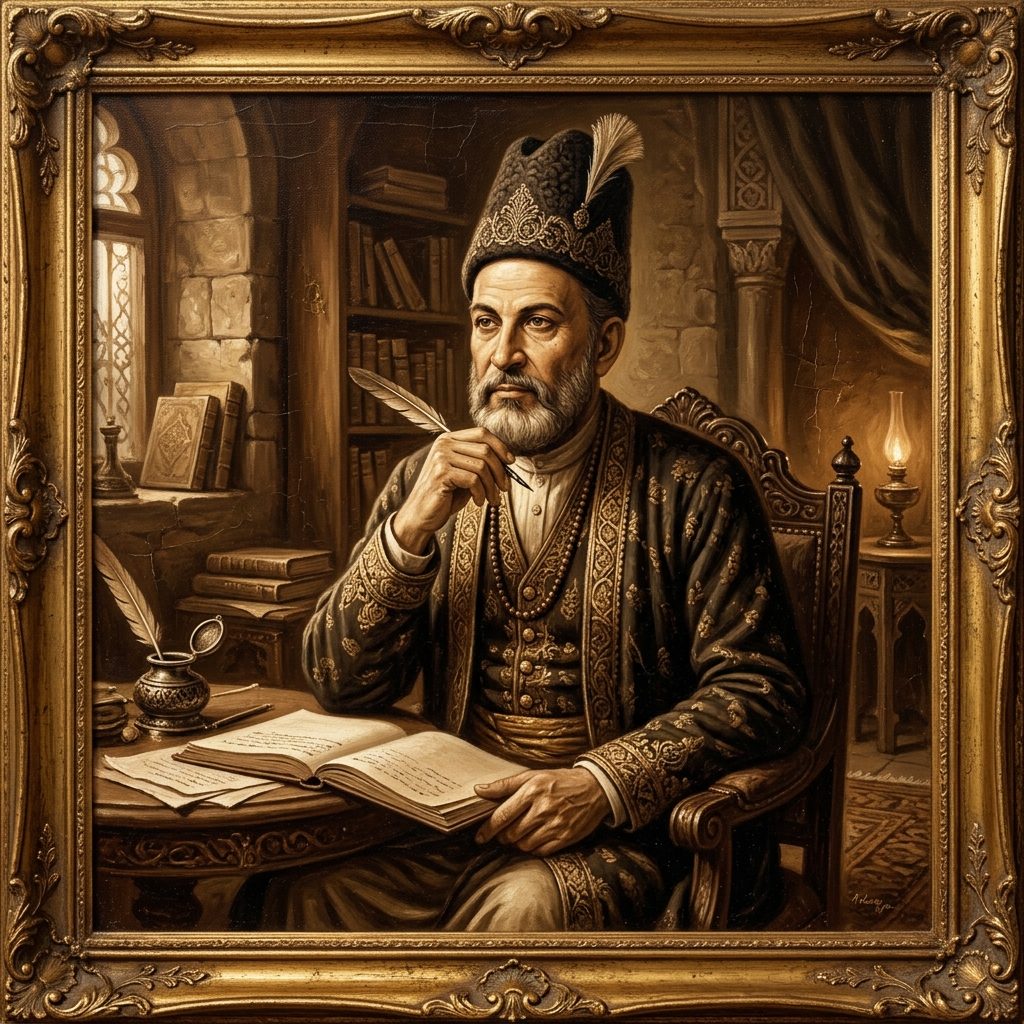
Agha Hashar Kashmiri
The Shakespeare of Urdu — the playwright whose ghazals still sing. Agha Hashar Kashmiri (1879–1935), born Muhammad Shah on 3 April 1879 at Banaras, was the Urdu stage's great playwright-poet — the man remembered as the Shakespeare of Urdu. His father, Ghani Shah, had come to Banaras from Kashmir, and the boy grew up between Arabic and Persian learning and the travelling Parsi theatre companies that passed through the city. He began writing verse at seventeen, and wrote his first play, Aaftaab-e-Mohabbat, at eighteen; when an elder of the theatre dismissed playwriting as no work for a boy, he took the taunt as a challenge and made the stage his life. He had already gone to Bombay at fourteen, and he rose through its theatre companies — his first play for the New Alfred Theatrical Company, Mureed-e-Shak, drawn from Shakespeare's The Winter's Tale, was a success, and his pay rose from fifteen rupees a month to forty. Over the following decades he wrote plays in Urdu, Hindi and Bangla: Shakespeare retold for Indian audiences — Shaheed-e-Naaz, Said-e-Hawas, Safaid Khoon after King Lear, Khwab-e-Hasti after Macbeth — and stories from the Ramayana and Mahabharata, above all Sita Banbas and Bilwa Mangal, with Yahudi Ki Ladki the most staged of them all. He worked in Bombay and in Calcutta, and his plays carried ghazals and songs inside their dialogue, so his verse travelled on the stage as well as on the page. He married the classical singer Mukhtar Begum, elder sister of Farida Khanum. Shortly before his death he moved to Lahore to try his hand at film production, and he died there in 1935, aged 56, and was buried in the Miani Sahib graveyard. His ghazals are still sung — the spring breeze that betrays a lover's secret, the world forgotten in remembrance, the road of the beloved set against the road of the mosque.
Follow Agha Hashar Kashmiri
0 FollowersReceive instant email alerts whenever new Ghazals, Nazms, or Couplets by Agha Hashar Kashmiri are published.