
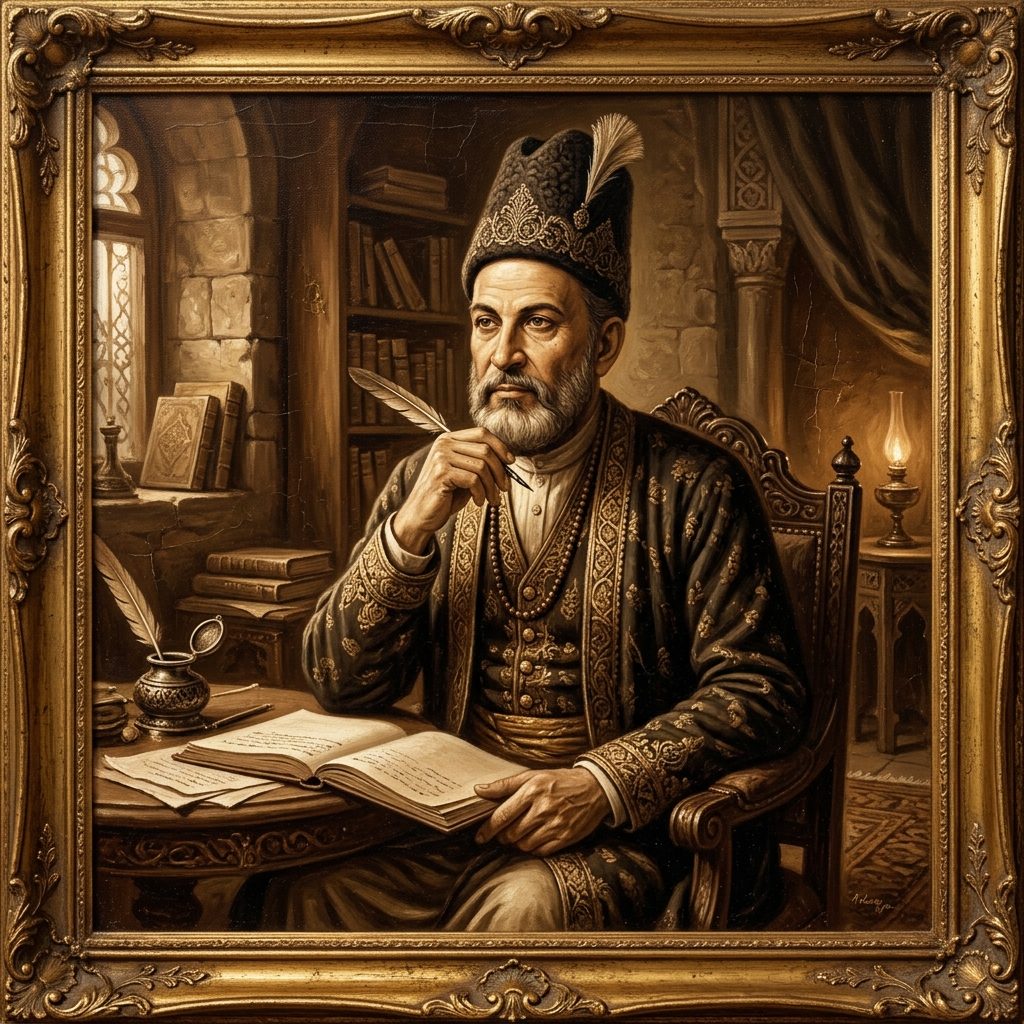
Ahmed Raza Khan Barelvi
Bareilly's Ala Hazrat — the thorn-strewn road, and the Forgiving One at its end. Ahmed Raza Khan Barelvi (1856–1921), known to his followers as Ala Hazrat, was born Muhammad on 14 June 1856 in the Jasoli quarter of Bareilly, into a Barech Pashtun family that had come from Kandahar by way of Lahore and once administered the Sheesh Mahal of Lahore. Schooled by his father, the scholar Naqi Ali Khan, he mastered the religious sciences while still young, and at twenty-two became a disciple of Shah Aale Rasool of Marahra, receiving leave to guide others in several Sufi orders. He founded the seminary Manzar-i Islam at Bareilly in 1904 and, in 1920, the organisation Jamaat Raza-i Mustafa. A Hanafi jurist of the Qadiri way, he wrote several hundred works in Arabic, Persian and Urdu: his rulings fill the thirty-volume Fatawa Razawiyya, his Urdu rendering of the Quran, Kanz ul-Iman, is still widely read, and his book of devotional verse, Hadaiq-e-Bakhshish (1907), holds the naats for which he is loved — among them the salutation "Mustafa Jaan-e-Rahmat pe laakhon salaam", sung in mosques across the world. He also wrote on mathematics and astronomy, and made the pilgrimage to Mecca twice. He died at Bareilly on 28 October 1921, aged sixty-five, and his shrine there is visited by multitudes every year; the movement that bears his city's name counts more than two hundred million followers.
Follow Ahmed Raza Khan Barelvi
0 FollowersReceive instant email alerts whenever new Ghazals, Nazms, or Couplets by Ahmed Raza Khan Barelvi are published.