
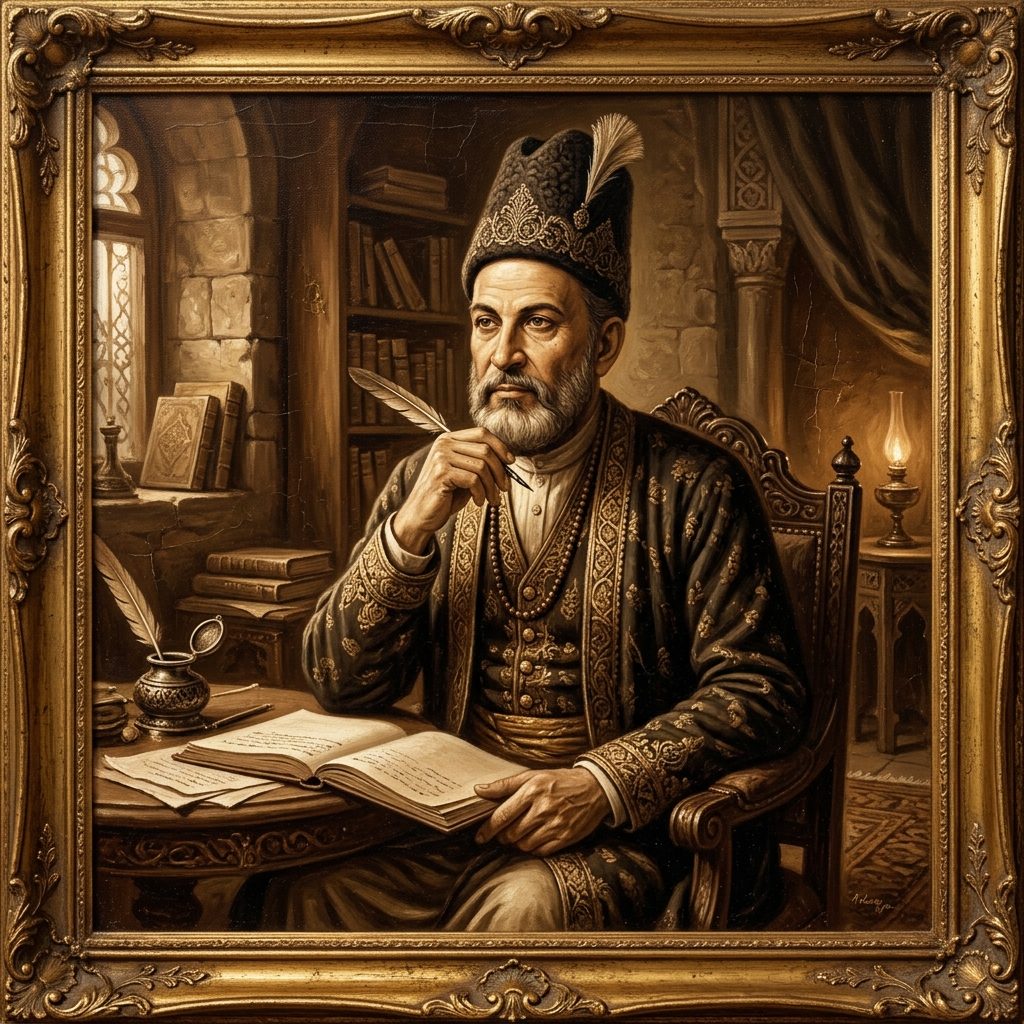
Allama Shibli Nomani
Allama Shibli Nomani (1857–1914), born at Bindwal in Azamgarh district, was the scholar who gave Urdu its modern historiography. Taught first by the rationalist Maulana Muhammad Farooq Chirayakoti and then, on Hajj, by scholars in Arabia, he joined Sir Syed Ahmad Khan's Anglo-Mohammedan College, Aligarh, in 1882 as professor of Arabic and Persian, where sixteen years beside Thomas Arnold opened him to Western thought without loosening his oriental roots. After Sir Syed's death he advised Hyderabad State on education, then served as principal of Nadwatul Ulama (1908–1913), before returning to Azamgarh. His biographies — above all Al-Farooq — set a new standard: history written from sources, in lucid Urdu prose, rather than panegyric. As a critic, Sher-ul-Ajam made him a founder of Urdu literary criticism. He founded Shibli National College in 1883 and, in his last year, bequeathed his house and orchard for Darul Mussanifin (the House of Writers) at Azamgarh; its first formal meeting was held on 21 November 1914, three days after his death, and his disciple Syed Sulaiman Nadvi carried the house — and Sirat-un-Nabi — forward. His poetry, small in bulk beside his prose, carries the same mind: a reformer's grief for a community that had lost its learning, and a believer's address to eternity.
Follow Allama Shibli Nomani
0 FollowersReceive instant email alerts whenever new Ghazals, Nazms, or Couplets by Allama Shibli Nomani are published.