
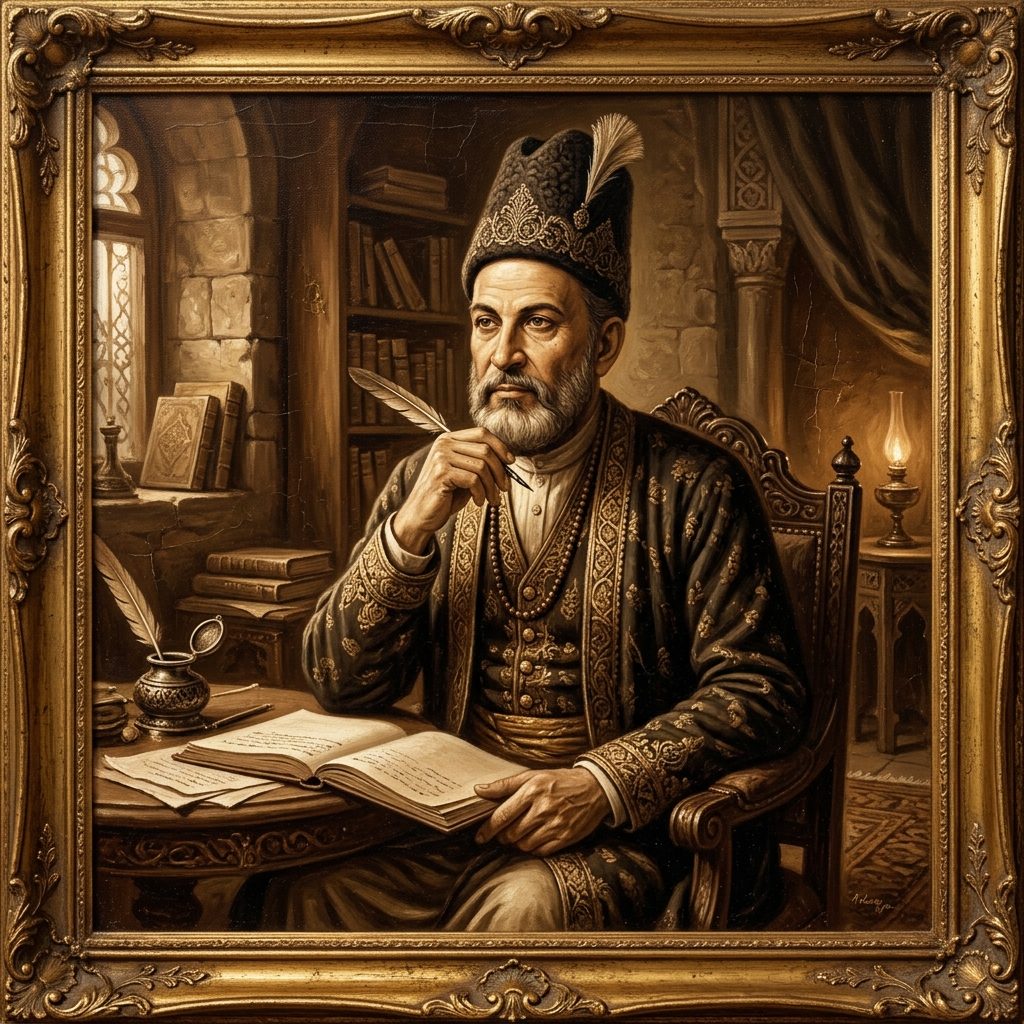
Amjad Hyderabadi
Hyderabad's Hakim of Poets — the rubai that survived the flood. Amjad Hyderabadi (1888–1961), born Syed Ahmed Hussain in March 1888 at Hyderabad, was the Deccan's master of the rubai — the four-line poem — and is remembered as Hakim-al-Shuara, the Hakim of Poets. He lost his father while still a young boy — his father, Sufi Syed Rahim Ali, was a man of deep religious conviction — and was brought up by his mother. He learned his first lessons in a maktab, then studied Arabic and Persian under the Nizamia course at Madarsa Nizamia in Hyderabad, and began writing verse at fourteen, guided at first by Habeeb Kantori. To earn his living he taught at Darul Uloom School and then served in the accounts and audit department of Hyderabad state, retiring from the Accountant General's office. On 28 September 1908 the Musi river flooded beyond control: his mother, his wife and his children were washed away, and he alone of his family survived, one of a hundred and fifty who lived by clinging to the branches of a tamarind tree. The loss runs through his rubais ever after. He wrote his long poem Qayamat-e-Soghra — The Minor Doomsday — on that night of flood, and his best-known rubai, opening "Har cheez musabbib-e-sabab se mango…", tells the sufferer to ask only of God. He tried his hand at every form, but it is the rubai that carries his name: fifteen books of verse and prose, among them three volumes of Rubaiyat-e-Amjad, two of Riyaz-e-Amjad, and Khirqa-e-Amjad, Nazr-e-Amjad, Jamal-e-Amjad, Gulistan-e-Amjad, Payam-e-Amjad and Hajj-e-Amjad. His rubais are mystic and philosophical in flavour, yet plain in speech — free of the old ornaments of beauty and the rose and nightingale — and singers still carry them, as the Warsi Brothers did in their qawwalis. He died in March 1961, aged seventy-three, and is buried at the Dargah of Hazrat Shah Khamosh in Hyderabad.
Follow Amjad Hyderabadi
0 FollowersReceive instant email alerts whenever new Ghazals, Nazms, or Couplets by Amjad Hyderabadi are published.