
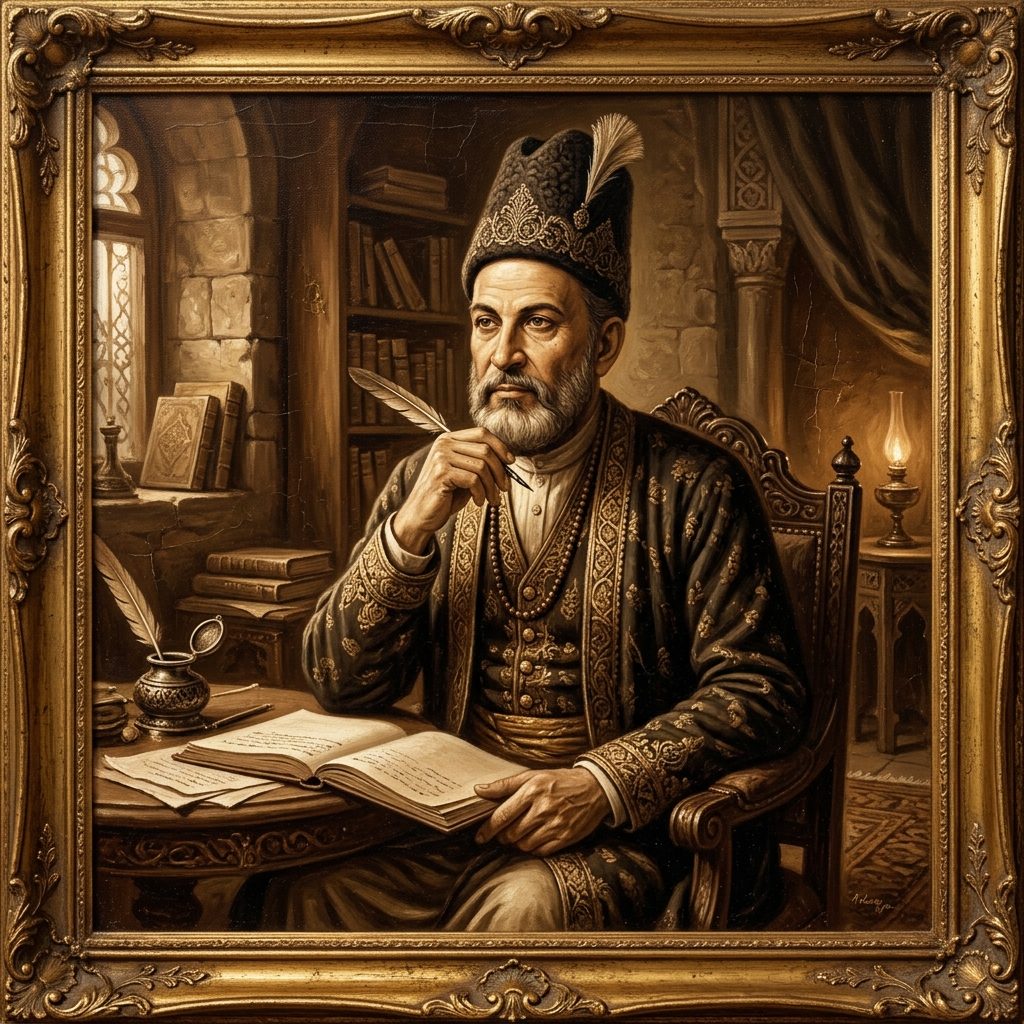
Dina Nath Nadim
The voice that gave Kashmiri poetry its modern tongue — the valley, singing of itself. Dina Nath Nadim (1916–1988), born Dina Nath Kaul on 18 March 1916 at Sheshyar, Habba Kadal, in Srinagar, was the Kashmiri poet with whom modern Kashmiri poetry begins. His father, Shankar Kaul, died when he was still a small boy, and his widowed mother raised him and his elder sister, singing the verses of Lal Ded to them as they grew. He was schooled in Srinagar, matriculated in 1930, took his BA in 1943 and his teacher's degree in 1947. He began by writing in English, then in Urdu and Hindi — between 1938 and 1946 he wrote mainly in Urdu, under the spell of Chakbast and Josh Malihabadi — and his first poem in Kashmiri came in 1942, a hymn to Mother Kashmir. He was arrested in 1938 for his part in the struggle against autocratic rule, and in the years that followed he became one of the leading lights of the National Cultural Front, founded in 1947 to defend the valley and hold its communities together. He joined the Communist Party in 1950 and was elected general secretary of the Progressive Writers Association of Kashmir the same year. He taught for years at the Hindu High School in Srinagar, of which he became head, served as Assistant Director of Social Education, and helped to found the Gandhi Memorial College, the first private degree college in Jammu and Kashmir. Into Kashmiri he brought the sonnet, free verse and blank verse, and above all the opera: his Bombur ti Yemberzal, the Bumblebee and the Narcissus Flower, staged in 1953, was the first opera in the language, and Vitasta, the river Jhelum in song, followed it. His collection Shihil Kul, the Shady Tree, brought him the Sahitya Akademi Award in 1986, and he had received the Soviet Land Nehru Award in 1971. Of his roughly one hundred and fifty poems — in Kashmiri, Hindi, Urdu and English — the best loved are Me Chhum Aash Paghich, I Am Hopeful of Tomorrow, his great anti-war poem, and Myon Watan, My Homeland, whose lines on the Shalimar garden and the lotus of the Dal Lake were quoted in the Union Budget speech of 2020. He died in Srinagar in 1988, a year after receiving the Sahitya Akademi Award, and is remembered as the gentle colossus of modern Kashmiri literature — the poet who took the valley's own tongue and made it speak of freedom, of the common man, and of tomorrow.
Follow Dina Nath Nadim
0 FollowersReceive instant email alerts whenever new Ghazals, Nazms, or Couplets by Dina Nath Nadim are published.