
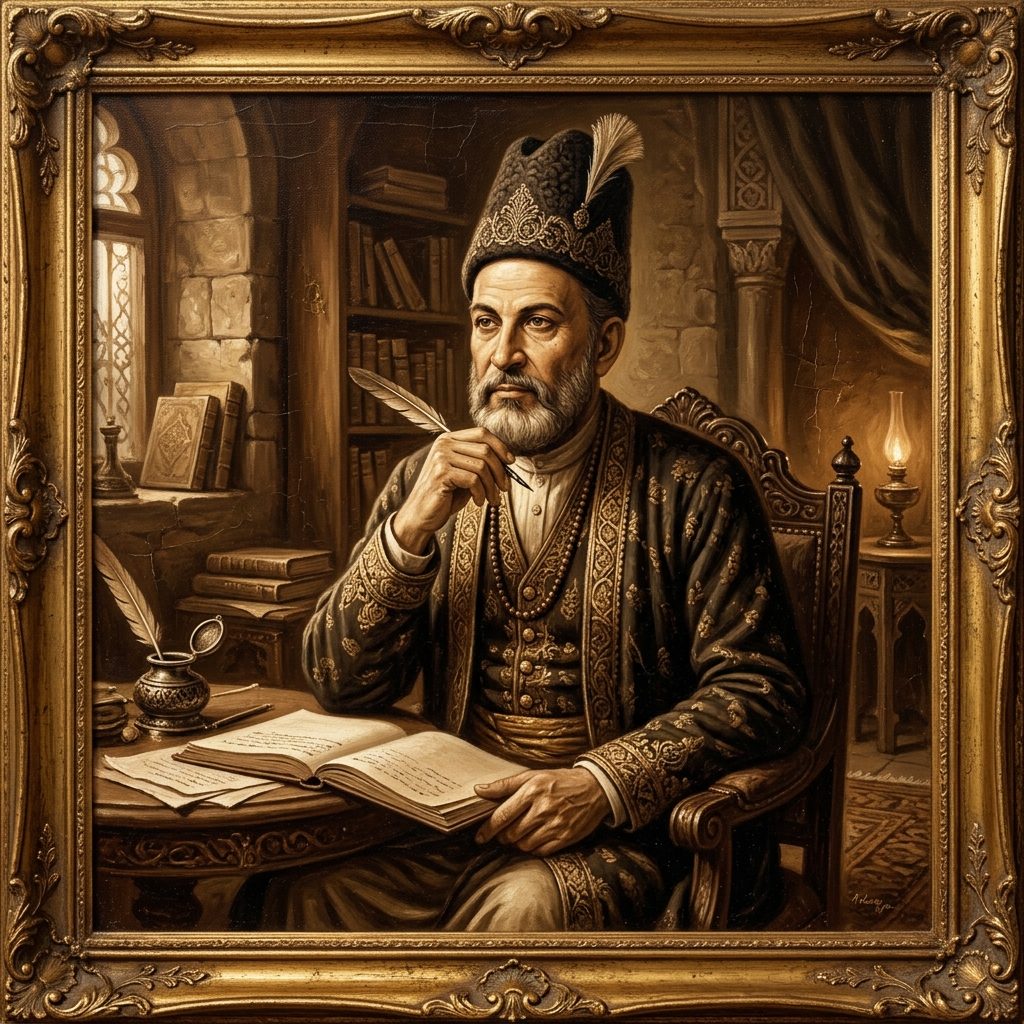
Ghanimat Kunjahi
Muhammad Akram Ghanimat Kunjahi (d. c. 1713), known as Ghanimat, was a Persian poet and Sufi of Punjab in the Mughal Empire, born at Kunjah, a small town near Gujrat, in the second half of the seventeenth century; the year of his birth is not known. He came from a long line of jurists — a family of muftis — of Kunjah, and was a disciple of Sayyid Muhammad Salih, himself a disciple of the saint Naushah Ganj Bakhsh, in the Qadiri order of Sufis. He studied poetry and rhetoric with Mir Muhammad Zaman Rasekh of Sirhind, and is reported to have travelled to Kashmir, Kabul and Delhi. In 1685, while in the service of Mirza Artoq Beg, the military commander of Sialkot, he composed the work for which he is best remembered, the mathnawi Nairang-i Ishq (The Talisman of Love) — a romance of some 1,500 lines set in the Punjab of his own day, telling the love of Aziz and Shahid. His Diwan contains 233 ghazals and twelve rubaiyat, and his other mathnawi, Gulzar-i Mohabbat, runs to 591 lines; his letters and a prose debate between the rose and the narcissus also survive. He wrote in Persian in the Indian style, sabk-i Hindi, prized for its fresh imagery, its fondness for the ghazal, and its close attention to the life around him. He was still alive in 1713, when he praised the emperor Farrukhsiyar in the opening of Gulzar-i Mohabbat, and his death is spoken of by his nephew in a work written in 1714; he is held to have died towards the end of 1713, and lies buried in his native Kunjah, where his tomb became a place of reverence.
Follow Ghanimat Kunjahi
0 FollowersReceive instant email alerts whenever new Ghazals, Nazms, or Couplets by Ghanimat Kunjahi are published.