
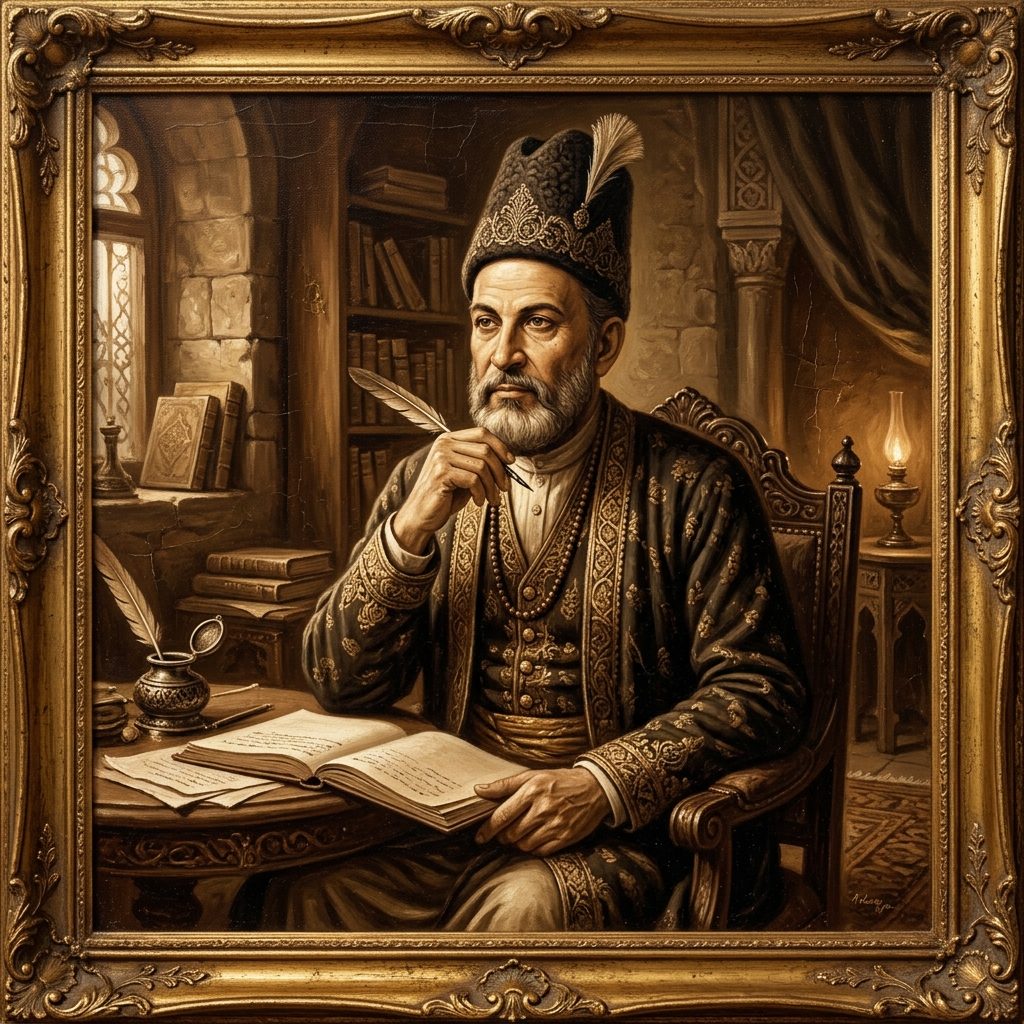
Ismat Chughtai
Urdu fiction's fearless daughter — the crooked line against every straight rule. Ismat Chughtai (1915–1991), born on 21 August 1915 at Badayun in Uttar Pradesh, was the boldest woman's voice in modern Urdu fiction — the writer who drew a crooked line beside every straight rule of her world. She was the ninth of ten children of Mirza Qasim Baig Chughtai, a civil servant, and Nusrat Khanam; the family moved with her father's postings, and she grew up at Jodhpur, Agra and Aligarh, mostly in the company of her brothers, her sisters having married young. Her second-eldest brother, the novelist Mirza Azim Baig Chughtai, was her mentor, and at Aligarh she met the doctor and writer Rashid Jahan, who had helped to make the storm over Angarey. She studied at the Women's College at Aligarh and took her bachelor's degree from Isabella Thoburn College at Lucknow in 1940, and began her working life as the headmistress of a girls' school in the state of Jawra. Her first published work, the play Fasadi (The Troublemaker), appeared in the journal Saqi in 1939; her first novella, Ziddi (The Wayward), followed in 1941, and her first collections of stories in 1941 and 1942. Then came the story that changed her life: Lihaaf (The Quilt), published in 1942, told through a young girl's eyes of a begum's lonely marriage and her closeness to her maid. Its frankness brought an obscenity charge, and she was summoned before the Lahore High Court; the trial of 1945 ended in her acquittal, and Manto, charged over his own story Bu, travelled to Lahore with her. Her great novel, Tedhi Lakeer (The Crooked Line), is the story of a woman's life told against the fading order of the old Muslim household — the book her readers still call her masterpiece. In 1942 she married the film-maker Shahid Latif and moved to Bombay, where she wrote stories and dialogue for his films — Arzoo, Fareb, Sone Ki Chidiya — and the story of Garm Hava, the film of Partition, which won the national award for best story. She and Latif had two daughters, Seema and Sabrina. With Manto, Rajendra Singh Bedi and Krishan Chander she is counted as the fourth pillar of modern Urdu fiction. She was honoured with the Padma Shri in 1976. In the late 1980s Alzheimer's disease narrowed her life; she died at her house in Bombay on 24 October 1991, aged seventy-six, and, as her will asked, her body was cremated — she had written of her fear of burial. Her memoir, Kaghazi Hai Pairahan (A Life in Words), takes its title from a line of Ghalib's, and tells, in her own voice, how a girl who played football and rode bicycles became the writer no one could silence.
Follow Ismat Chughtai
0 FollowersReceive instant email alerts whenever new Ghazals, Nazms, or Couplets by Ismat Chughtai are published.