
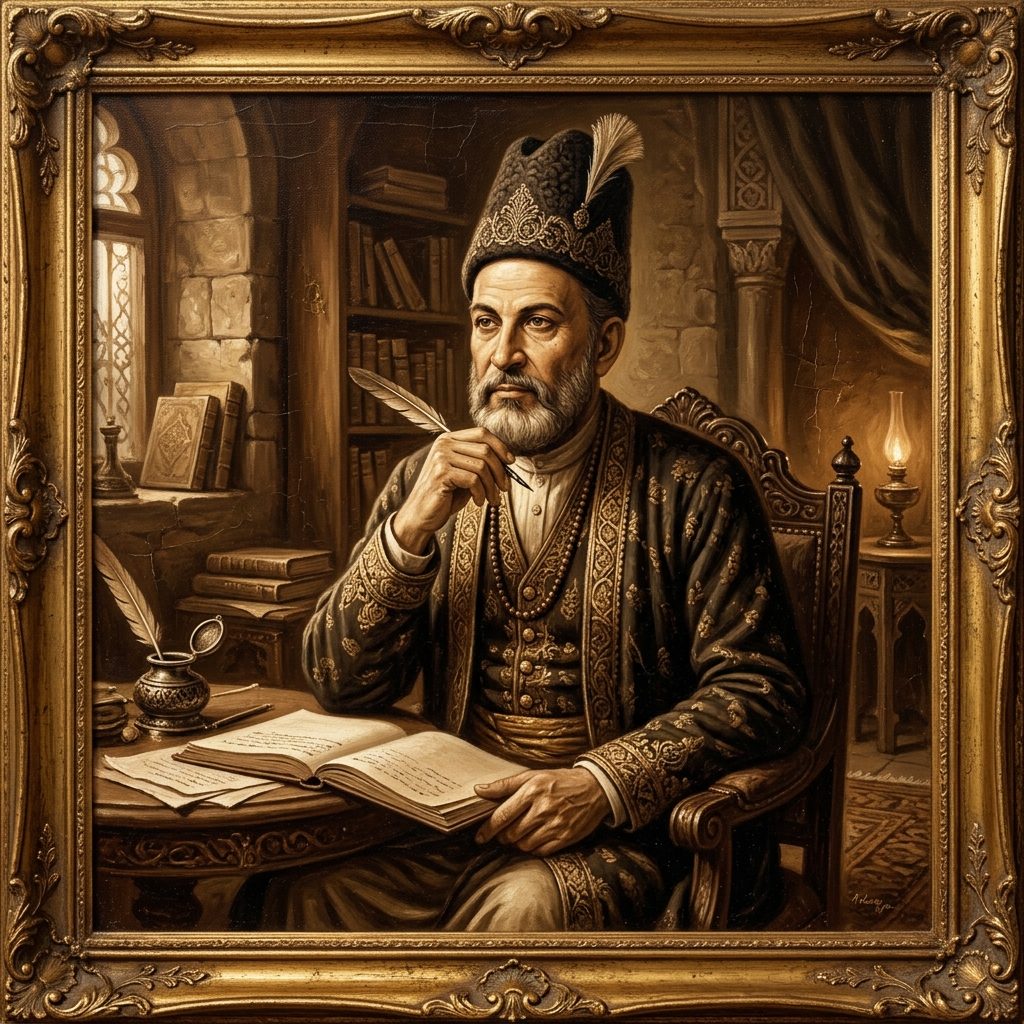
Kazi Nazrul Islam
Bengal's Rebel Poet — the comet who carried the ghazal into a new language. Kazi Nazrul Islam (1899–1976), born on 24 May 1899 at Churulia in the Burdwan district of Bengal, was the Bengali poet, songwriter and rebel whom Bangladesh honours as its national poet. He was born into a poor family of kazis — his father Kazi Fakir Ahmed served as the prayer-leader of the village mosque — and as a boy he was called Dukhu Mia, the sorrowful one, a name that stayed with him. He worked as a muezzin, sang with a travelling theatre troupe, and in 1917 joined the 49th Bengal Regiment, serving in Karachi, where he read Persian poetry and began to write. His first poem, "Mukti" (Freedom), appeared in July 1919. Back in Calcutta he poured out poems, songs, stories and novels; his long poem "Bidrohi" (The Rebel), published in January 1922, made him famous overnight and gave him the name by which Bengal still knows him — Bidrohi Kobi, the Rebel Poet. In 1922 he brought out his fortnightly Dhumketu (The Comet) and his first book of poems, Agniveena (The Lyre of Fire); the same year he was arrested for sedition, and in prison he gave his defiant deposition Rajbandir Jabanbandi and kept a forty-day hunger strike. He married Pramila Devi in 1924. Across the 1920s and 1930s he wrote and composed nearly four thousand songs — the body of work known as Nazrul Geeti — including devotional songs to the goddess Kali and Islamic songs that are still sung in Ramadan, and he did what no Bengali before him had done: he carried the ghazal, with its Persian-Urdu music, into Bengali, composing and singing ghazals of his own between 1927 and 1930, and he also wrote ghazals in Urdu and devotional songs in Hindi. He knew Bengali, Urdu, Persian, Arabic, Hindi, Sanskrit and English, translated Hafiz and Khayyam, and set more than thirty Quranic verses into Bengali. In 1942, at forty-three, a mysterious illness took his voice and his memory, and he lived the remaining thirty-four years of his life in silence. In 1960 India honoured him with the Padma Bhushan; in 1972 he was brought to Dhaka and given the status of national poet of Bangladesh, with citizenship of the new country; the University of Dhaka gave him an honorary doctorate in 1974, and he received the Ekushey Padak in 1976. He died at Dhaka on 29 August 1976, aged seventy-seven, and lies buried beside the mosque of Dhaka University — the resting place he had once asked for in a song.
Follow Kazi Nazrul Islam
0 FollowersReceive instant email alerts whenever new Ghazals, Nazms, or Couplets by Kazi Nazrul Islam are published.