
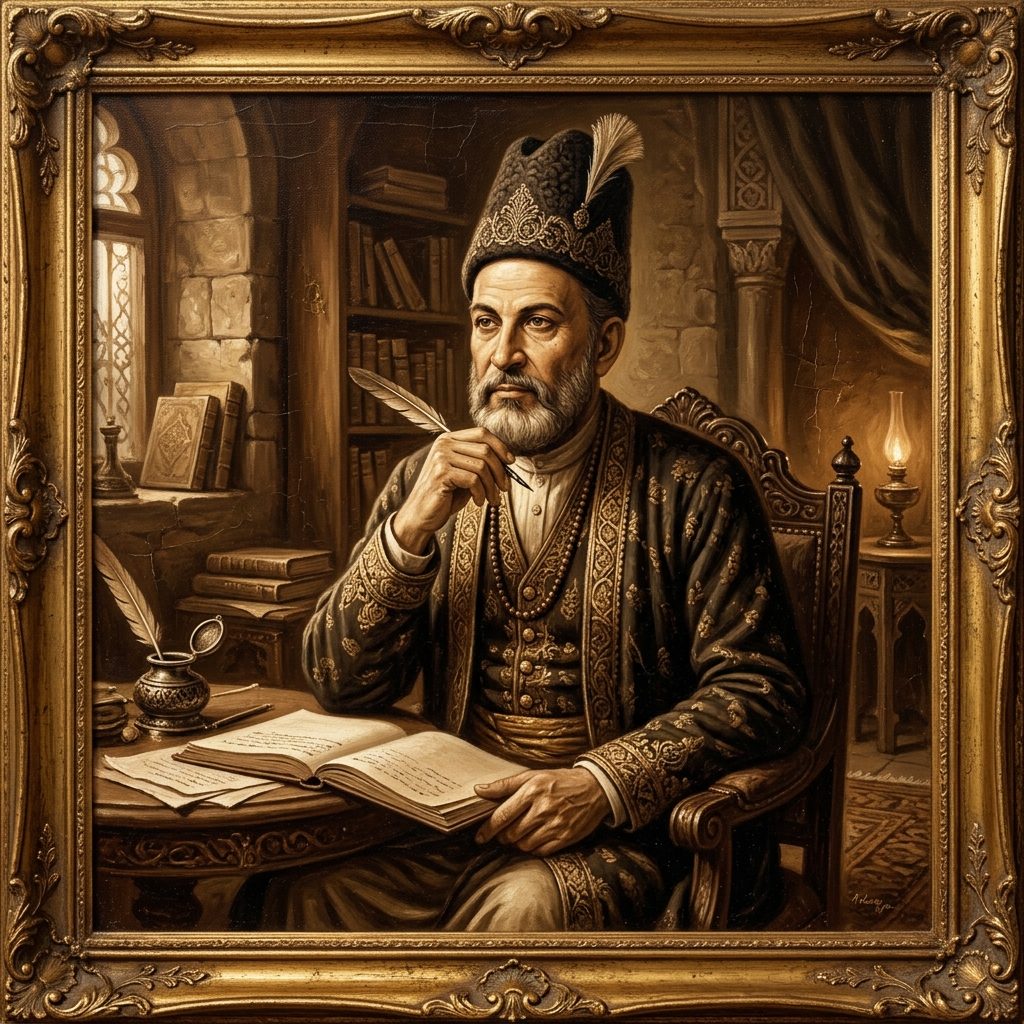
Mian Muhammad Bakhsh
Mian Muhammad Bakhsh (1830–1907) was a Punjabi Sufi saint-poet of the Qadri order, and the last great voice of classical Punjabi Sufi poetry. He was born in 1830 at Khari Sharif, near Mirpur, into a family of the Gujjar people, of the Dedhar clan — his father was Mian Shams-ul-Din Qadri, and he counted himself a fourth-generation spiritual descendant of Pir-e-Shah Ghazi Qalandar Damriyan Wali, whose shrine stands at Khari Sharif. He wrote in the Pothohari speech of his country, a Punjabi rich in Persian and Arabic words, and in all he is credited with some fifteen works — retellings of Sohni Mahiwal, Shireen Farhad and Mirza Sahiban among them, and a commentary on the Arabic *Qasidat-ul-Burda*. His great work is *Saif-ul-Malook*, which he himself called *Safar-ul-Ishq*, the Journey of Love: the story of Prince Saif-ul-Malook, son of the King of Egypt, who falls in love with the fairy Badi-ul-Jamal from her picture on a cloth and sets out to find her — a tale drawn from the Thousand and One Nights, told in the manner of the Persian masnavi, in more than 9,000 verses across 64 chapters. He finished it in the month of Ramadan, 1279 AH (1863), when he was thirty-three years old, and it has been the most loved telling of the tale ever since — read, recited and sung across the northern Punjab and Kashmir, and still in print more than a century after it first appeared. He died in 1907, on the 7th of Dhu al-Hijjah 1324 AH, after a stroke that struck him at prayer, and was buried at Khari Sharif, where his shrine remains a place of devotion and of song.
Follow Mian Muhammad Bakhsh
0 FollowersReceive instant email alerts whenever new Ghazals, Nazms, or Couplets by Mian Muhammad Bakhsh are published.