
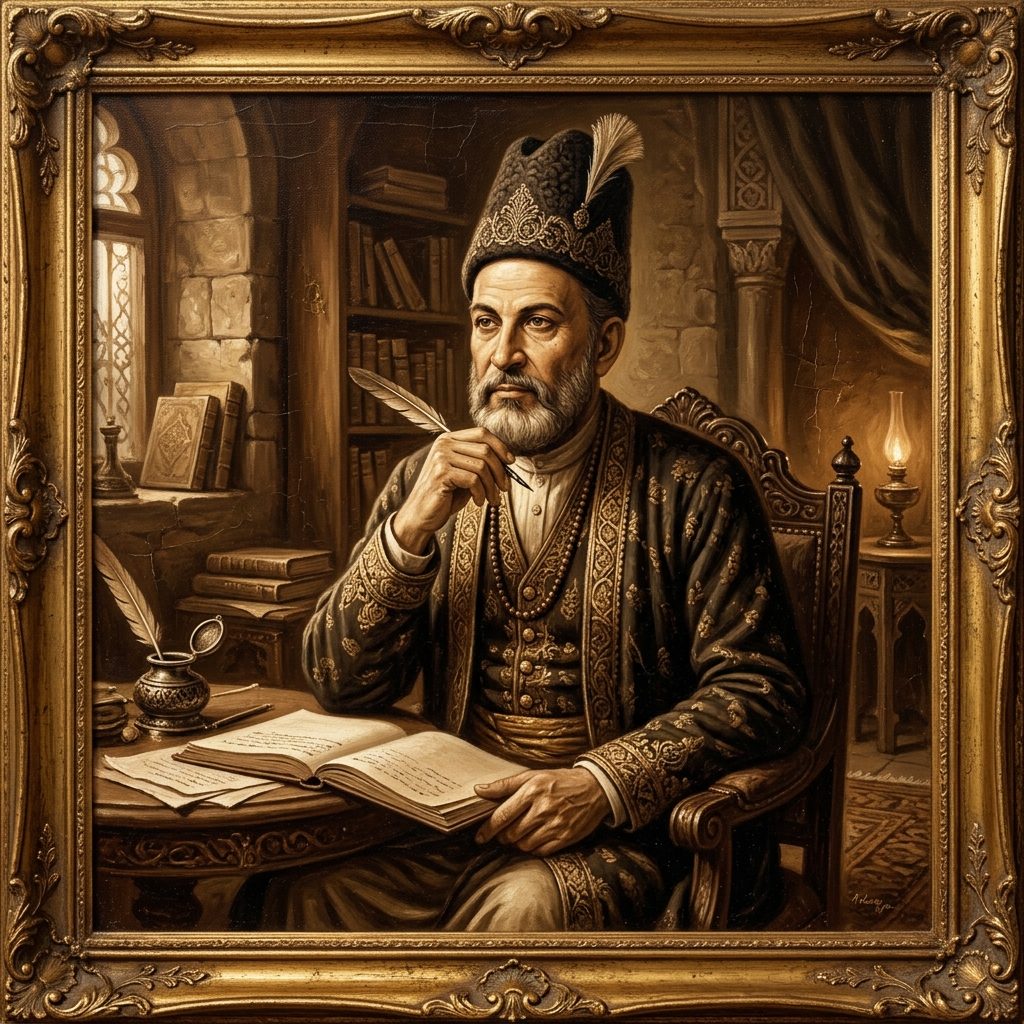
Mirza Kalich Beg
The Shakespeare of Sindh — one man, four hundred books, and a literature reborn. Mirza Kalich Beg (1853–1929), known also as Qaleech Baig, was born on 4 October 1853 at Tando Thoro, a village on the bank of the Phuleli Canal near Hyderabad in Sindh, and became the founder of modern Sindhi literature. His father, Fredunbeg, was a Georgian born in Tbilisi who had been enslaved in the wars with the Qajar dynasty and given as a boy to the Talpur emirs of Sindh — the family's journey from the Caucasus to the Indus is told in A Georgian Saga (2005), by Meherafroze Mirza Habib, a descendant of the family. Kalich Beg began to compose poetry at seven or eight, reciting marsia in the Muharram gatherings, and went on to write more than four hundred and fifty books in forty-three fields — novels, dramas, histories, dictionaries, science, religion and poetry — in eight languages, knowing twenty-five. He served the British government as a tehsildar at Shikarpur and rose to Deputy Collector, retiring in 1910 after thirty years. His novel Zeenat is counted the first original Sindhi novel; his dictionary Lughat-e-Latifi (1914) unlocks the hard words of Shah Abdul Latif; his autobiography, Sao Pan Karo Pano — the green leaf and the black paper — is the first of its kind in Sindhi. He also wrote poetry in Sindhi, Persian, English and Urdu, and two of his Urdu poems — "Tere ishq ko main sada chahta hoon" and a second ode reported under the title "Ko Ana Sada Chahta Hon" — were set to music in his honour. In 1906 he received the Qaisar-e-Hind medal, and in 1924 the title Shams-ul-Ulama, sun among the learned. He died on 3 July 1929 and lies buried at Buland Shah, Tando Thoro.
Follow Mirza Kalich Beg
0 FollowersReceive instant email alerts whenever new Ghazals, Nazms, or Couplets by Mirza Kalich Beg are published.