
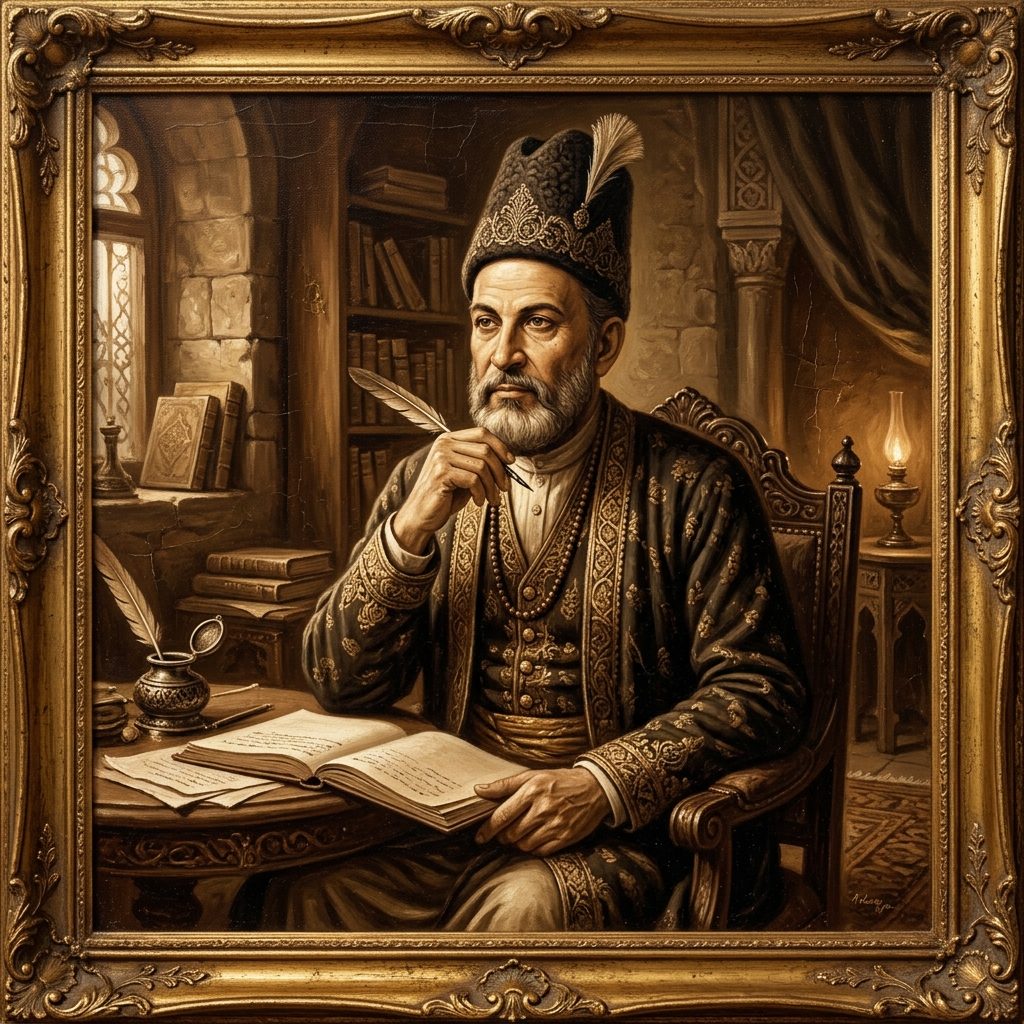
Muhammad Husain Azad
Muhammad Husain Azad (1830–1910), born in Delhi on 5 May 1830 into a Persian immigrant family, was the stylist who remade Urdu prose and the critic who wrote its first great literary history. His mother died when he was four; his father, Maulvi Muhammad Baqir, educated at Delhi College, bought a press in 1837 and launched the Delhi Urdu Akhbar — probably the first Urdu newspaper in northern India. Azad graduated from Delhi College in 1854 and joined his father's paper — until 1857, when the paper's support for the uprising cost his father his life: Baqir was executed by the British, and the whole joint family was thrown out of its house. After years of hardship and hiding, Azad migrated to Lahore in 1861, worked at the General Post Office and the Director of Public Instruction's office, and found his place when the Anjuman-e-Punjab was founded: lecturer in 1866, its secretary in 1867, then professor of Urdu and Persian at Government College, Lahore. In 1887 he founded the Azad Library and received the title Shams-ul-Ulama, Sun among the Learned. His Aab-e-Hayat (1880) — lives of Urdu poets and the story of the language itself — remains the foundation stone of Urdu literary history; around it stand Qisas-ul-Hind, Nairang-e-Khiyal, Sukhandan-e-Fars and Darbar-e-Akbari. As a poet he was the pioneer of the new natural nazm, writing on nature and everyday subjects instead of only rose and nightingale, beginning with "Shab-e-Qadr." He died at Lahore on 22 January 1910.
Follow Muhammad Husain Azad
0 FollowersReceive instant email alerts whenever new Ghazals, Nazms, or Couplets by Muhammad Husain Azad are published.