
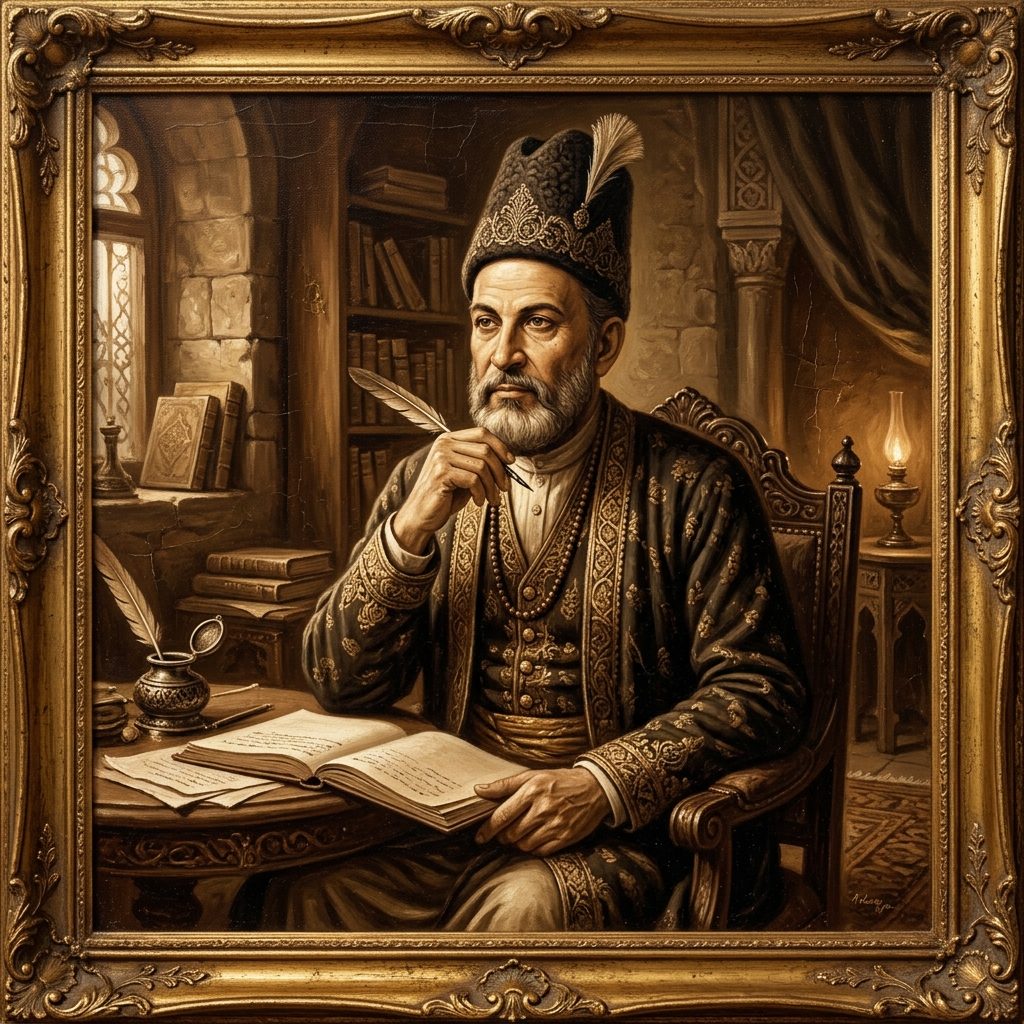
Mumtaz Mufti
The mind's own storyteller — from doubt to Sufism, one life searched twice. Mumtaz Mufti (1905–1995), born Mumtaz Husain on 11 September 1905 at Batala in the Gurdaspur district of the Punjab, was the Pakistani writer who turned the short story inward — from the street and the bazaar to the hidden workings of the mind, and from doubt to Sufism. He came of a scholarly family that had served as muftis and qazis in the Mughal time; his father was Mufti Muhammad Hussain, his mother Sughra Khanum. Schooled at Amritsar, Mianwali, Multan and Dera Ghazi Khan, he graduated in Philosophy and Economics from Islamia College, Lahore, in 1929. He began as a schoolteacher, then served as a civil servant under British rule, and his first published fiction, the story "Jhuki Jhuki Aankhen", appeared in 1932 — the story after which he became known as Mumtaz Mufti. After Partition he moved with his family to Pakistan. His early reading — Freud, Havelock Ellis, Alfred Adler, Dostoevsky — made him a religious sceptic; his lifelong friendship with the writer and mystic Qudrat Ullah Shahab turned him toward Sufism, and the turn is the hinge of his whole work. His two great autobiographical books tell the two halves of that journey: Ali Pur Ka Aeeli (1961), the lover who challenged the taboos of his time, and Alakh Nagri (1992), the devotee under Shahab's spell. Beside them stand his story collections — Un Kahi, Chup, Roghani Putlay, Samay Ka Bandhan — his sketches Okhay Log and Piyaz ke Chilkay, and his travel books Hind Yatra and Labbaik, the raw account of his Hajj of 1968. His last book was Talash, the search that had become his theme. Pakistan honoured him with the Sitara-e-Imtiaz in 1986, and India with the Munshi Premchand Award in 1989. He died at Islamabad on 27 October 1995, aged ninety, and lies buried at the H-8 Graveyard there; his son Uxi Mufti, himself a critic, set up a trust in his name.
Follow Mumtaz Mufti
0 FollowersReceive instant email alerts whenever new Ghazals, Nazms, or Couplets by Mumtaz Mufti are published.