
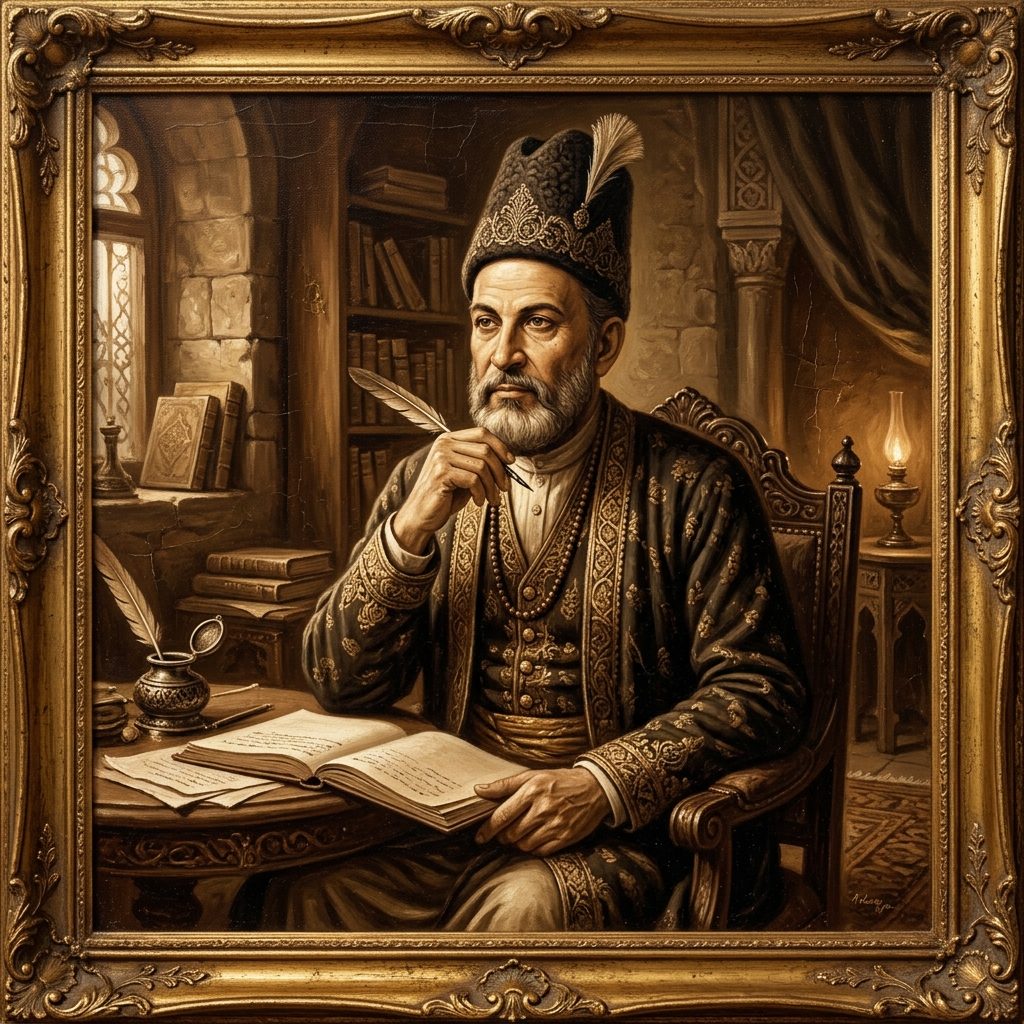
Rajab Ali Beg Suroor
Lucknow's tale-teller — the sun of judgement is a mote before her face. Rajab Ali Beg Suroor (1786–1869), born at Lucknow to Mirza Asghar Ali, was a poet and prose writer of the Lucknow school, remembered above all for Fasana-e-Ajaib, the tale of wonders that made his name immortal in Urdu letters. Schooled at Delhi, he learned Arabic and Persian in the old way and was accomplished besides in horsemanship, archery, calligraphy and music; a sociable and humorous man with a wide circle of friends, he counted Ghalib among his acquaintances. Around 1824 the ruler of Awadh, Ghazi-ud-Din Haider, took offence at something and had him turned out of Lucknow. The exile proved fruitful: at Kanpur, at the urging of Hakim Asad Ali, he turned to the prose that made him — above all Fasana-e-Ajaib, written in 1824, a dazzling, witty answer to Mir Aman's Bagh-o-Bahar, rich in wordplay, description and verse, his own and the masters'. When Naseer-ud-Din Haider came to the throne he was forgiven and allowed back to Lucknow, and under Wajid Ali Shah he joined the court poets at fifty rupees a month. The end of the kingdom of Awadh in 1856 cut off his patronage, and the upheaval of 1857 drove him from Lucknow. In his later years he went to Calcutta for treatment of his eyes, and on his return died at Banaras in 1869. Beside Fasana-e-Ajaib he left a shelf of books — renderings from Persian, tales, and collections of verse and prose — and a small body of ghazals in which the Lucknow manner, polished and playful, turns grave: the beloved's face outshining the sun of judgement, a prayer that ends in union or in death, and a thousand laments where a single sigh of refusal never arrives.
Follow Rajab Ali Beg Suroor
0 FollowersReceive instant email alerts whenever new Ghazals, Nazms, or Couplets by Rajab Ali Beg Suroor are published.