
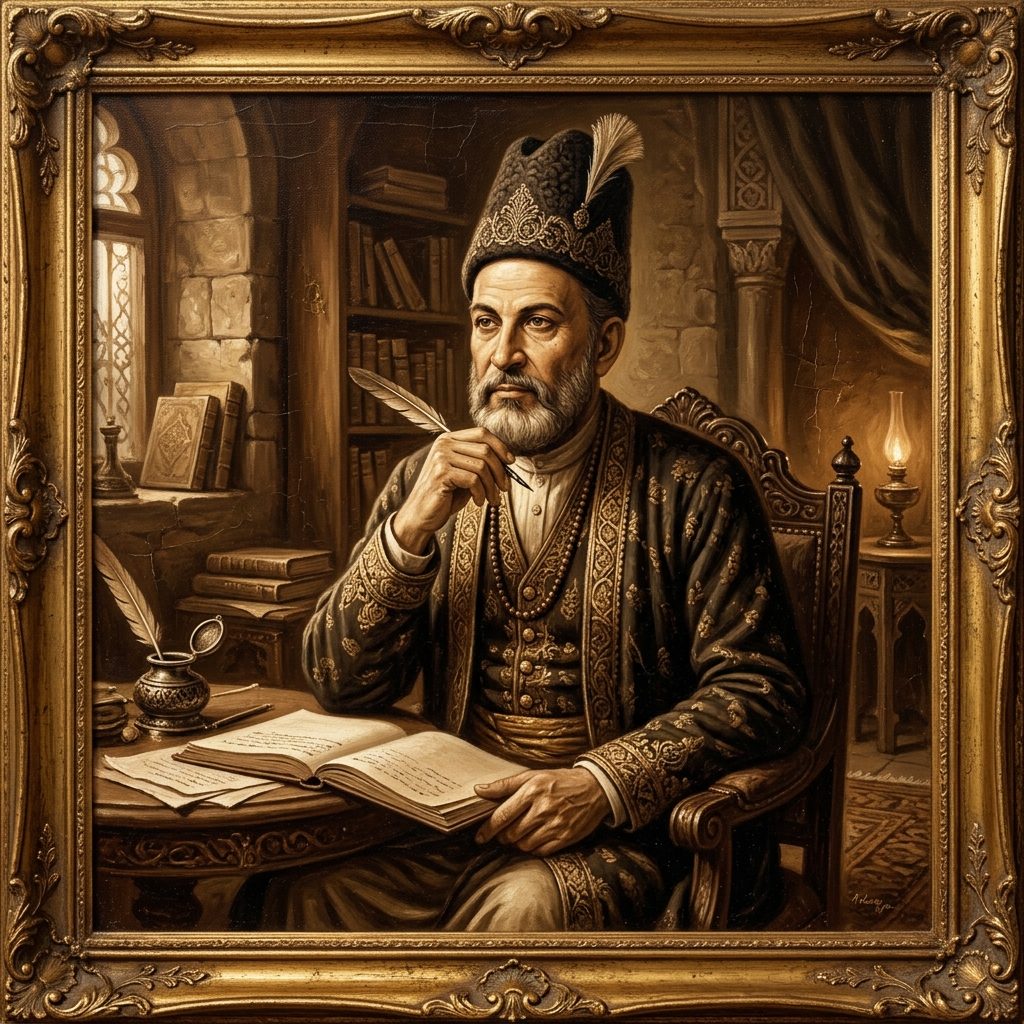
Ratan Nath Sarshar
Lucknow's great novelist — Azad and Khoji, and the city that laughed at itself. Ratan Nath Dhar Sarshar (1846–1903), known by his pen name Sarshar, was one of the pioneers of the Urdu novel — a novelist, journalist, translator and editor whose great book, Fasana-e-Azad, brought the streets of Lucknow alive in print. Born in 1846 into a Kashmiri Pandit family settled in Lucknow, he lost his father at the age of four and was brought up by his mother. He learnt Persian and Arabic in the old way, entered Canning College but left without taking a degree, and taught for a time in a school in Kheri district. In August 1878 he became editor of the Lucknow newspaper Avadh Akhbar, and in its pages his Fasana-e-Azad began to appear — the wandering tale of Azad and his companion Khoji, from the lanes of Lucknow to the battlefields of the Russo-Turkish War, told with the humour of Don Quixote and Pickwick and the colour of the old dastan. Published in four volumes between 1881 and 1883, it ran to more than three thousand pages and stands among the first novels in Urdu; Premchand later turned it into Hindi as Azad Katha. Later novels followed — Sair-e-Kohsar and Jam-e-Sarshar — and translations, among them Don Quixote as Khuda-e-Foujdar and the Alif Laila. In 1895 he moved to Hyderabad, where he worked for Maharaja Sir Kishen Pershad and edited the journal Dabdaba-e-Asifi. He wrote poetry too, and taught poetry to the Maharaja, but his fame rests on his prose. He died at Hyderabad on 21 January 1903.
Follow Ratan Nath Sarshar
0 FollowersReceive instant email alerts whenever new Ghazals, Nazms, or Couplets by Ratan Nath Sarshar are published.