
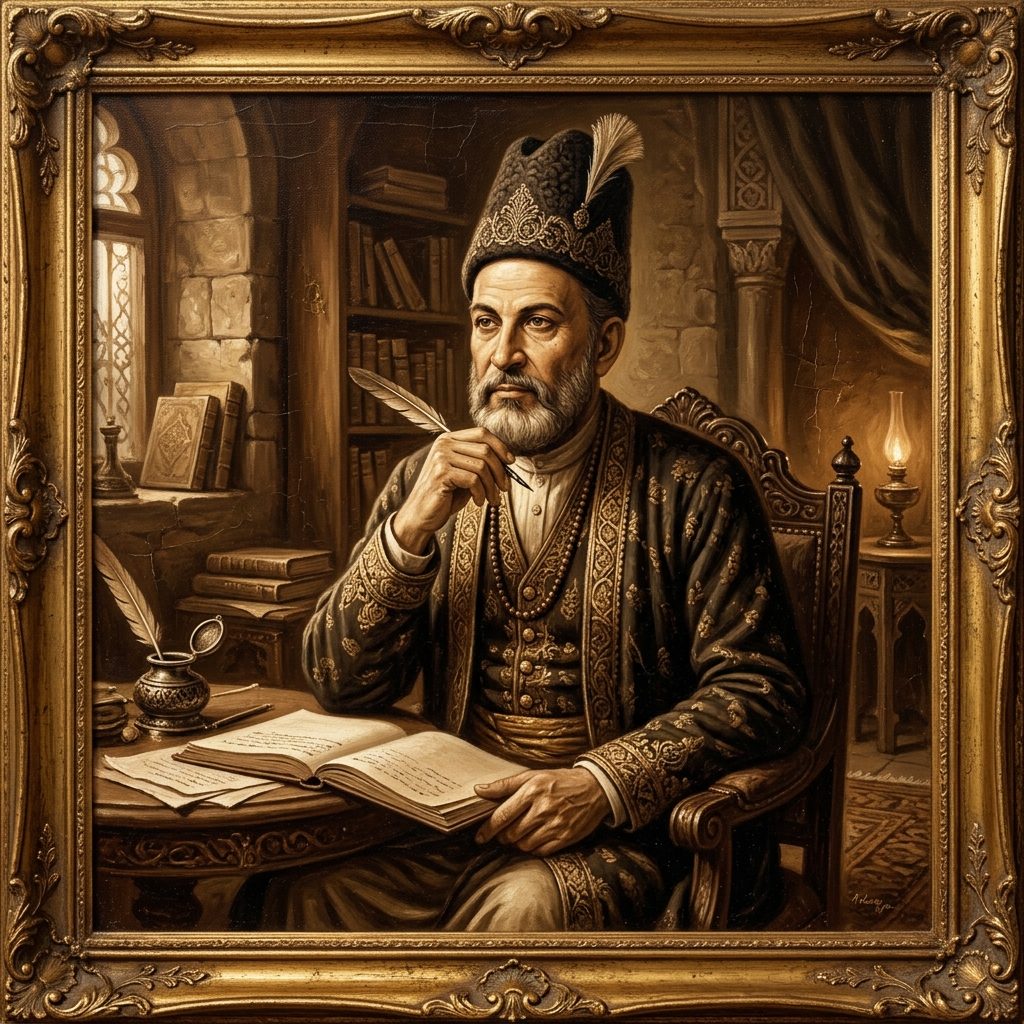
Saadat Hasan Manto
Urdu's greatest storyteller — the mirror that showed society its own face. Saadat Hasan Manto (1912–1955), born on 11 May 1912 at Paprodi, a village of Samrala in the Ludhiana district of the Punjab, was the short-story writer whom Urdu calls its greatest — the plain mirror of a society that preferred not to look at itself. He was born into a Kashmiri family settled at Amritsar, where his father Ghulam Hasan was a judge; his mother was Sardar Begum. A poor student — he twice failed his matriculation examination, even in Urdu — he found his teacher in 1933 in the scholar Abdul Bari Alig, who set him to read Russian and French writers and to translate Victor Hugo into Urdu. His first story, Tamasha (The Spectacle), told the Jallianwala Bagh massacre through the eyes of a seven-year-old child; it appeared in 1934. After a few months at Aligarh Muslim University, cut short by a mistaken diagnosis of tuberculosis, he worked in Lahore, then in Bombay, editing the weekly Musawwir and writing for the film studios, and in 1941–42 for the Urdu service of All India Radio in Delhi, the most productive stretch of his life. He married Safia in 1939; they had three daughters, Nighat, Nusrat and Nuzhat. In January 1948, after Partition, he left Bombay by ship and settled at Lahore, where the stories that made his name were written: Khol Do (Open It), Thanda Gosht (Cold Meat) and Toba Tek Singh, the asylum tale in which a Sikh patient dies in the no-man's land between the two new countries. His work — 22 collections of short stories, a novel, five series of radio plays, essays and sketches — took its subjects from the people respectable society preferred not to see: sex workers, the poor, the hungry, the mad. He was tried six times for obscenity, three times before 1947 and three times after, and never convicted; he was fined only once. He died at Lahore on 18 January 1955, aged forty-two, and lies buried at Miani Sahib. He had written his own epitaph, which was never carved on his grave. Pakistan honoured him after his death with a postage stamp in 2005 and the Nishan-e-Imtiaz in 2012, and two films have told his life.
Follow Saadat Hasan Manto
0 FollowersReceive instant email alerts whenever new Ghazals, Nazms, or Couplets by Saadat Hasan Manto are published.