
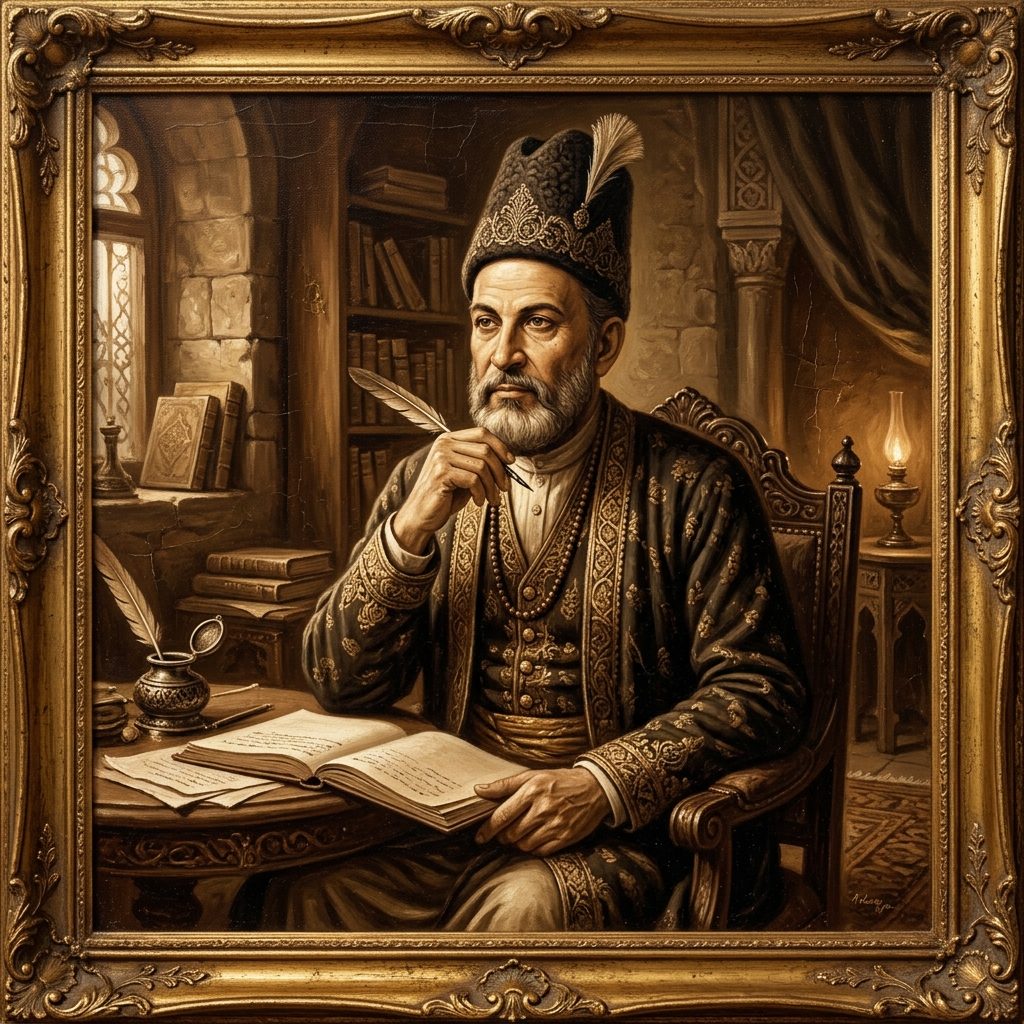
Shah Hussain
Shah Hussain (1538–1599) was the pioneer of the Punjabi kafi and the first great poet of early-modern Punjab. He was born in 1538 inside the walled city of Lahore — the same year Guru Nanak died — the son of Sheikh Usman, a weaver of the Dhudha Rajput clan; his grandfather had embraced Islam, and Hussain grew up among the looms, taking the weaver's images — thread, shuttle, cloth — into his verse for the rest of his life. As a young man he became the disciple of Shaikh Bahlol Daryai, founder of a branch of the Qadiri order, and studied until his mid-thirties. Then, at thirty-six, he turned away from formal prayer, put on red clothes, and began to sing and dance in the streets of old Lahore — a faqir by choice, not by birth. It was then that he met Madho Lal, a young Brahmin boy from Shahdara across the Ravi, thirty-eight years his junior; the bond between them became so complete that the two names fused into one, Madho Lal Hussain, and when Hussain died they were buried together at Baghbanpura, near the Shalimar Gardens. His kafis — short poems of four to ten lines, made to be sung — are the first of their kind in Punjabi: simple in language, built on the rhythms of folk song, and carrying a voice that is often a woman's, a weaver's, a sweeper's, never a dignitary's. More than 160 of them survive, passed down by singers until the oldest manuscript was written in 1804, and they are still sung today. He died in 1599, at sixty-one, near the Ravi, and every year his shrine fills with light for the Mela Chiraghan, the Festival of Lights — Lahore still keeps the feast of its red-clad saint.
Follow Shah Hussain
0 FollowersReceive instant email alerts whenever new Ghazals, Nazms, or Couplets by Shah Hussain are published.