
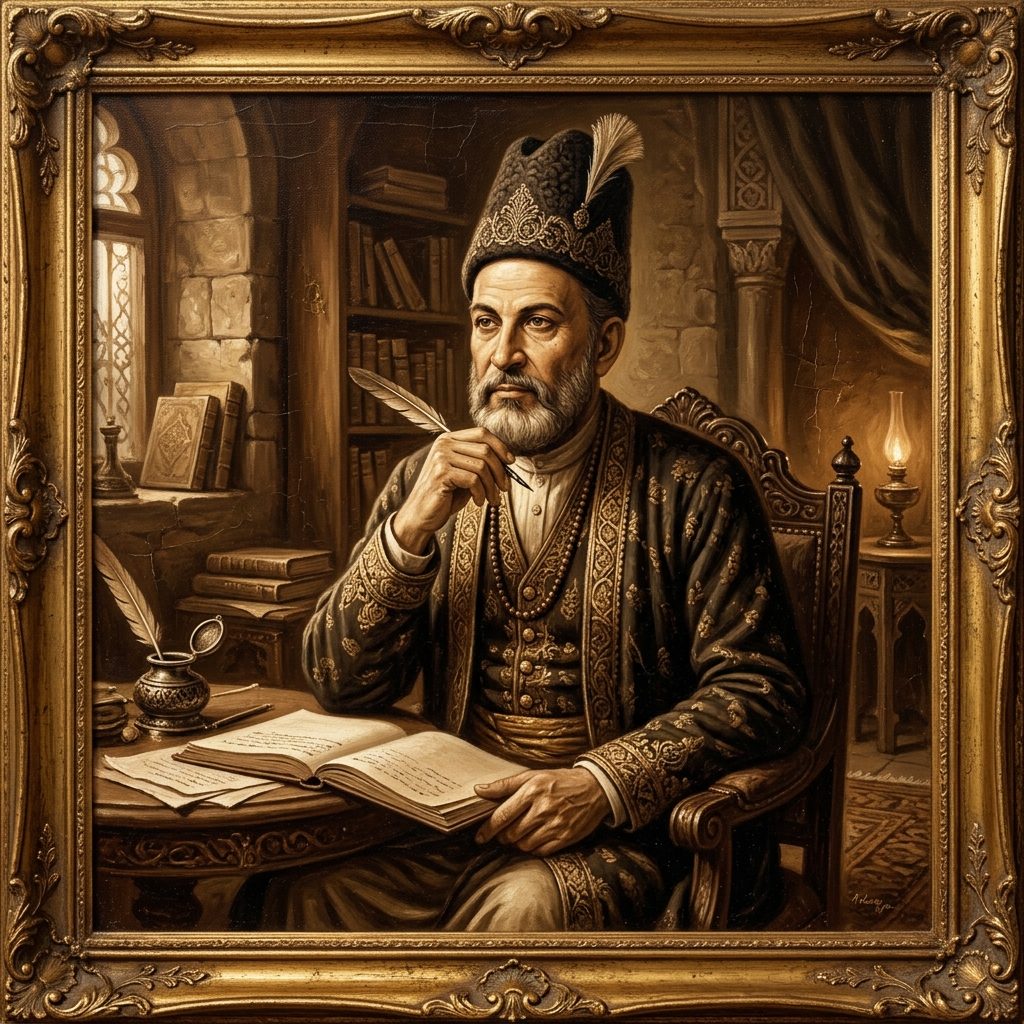
Shamim Karhani
Shamim Karhani (1913–1975), born Syed Shamsuddin Haider on 8 June 1913 at Karhan, a village in the Azamgarh region of eastern Uttar Pradesh, was an Indian Urdu poet of the Progressive movement whose verse carried the freedom struggle into the ghazal and the nazm. Born into a landowning family — his father was Syed Muhammad Akhtar, his mother Ummat ul Zehra — he took his pen name from his native village, and his elder brother Syed Azam Husain Azam was also an Urdu poet and journalist. He was schooled at Aligarh Muslim University and completed the Maulvi Kamil Munshi qualification; he is said to have composed his first couplet at the age of eight. He taught at Azamgarh, spent a short spell as a lyricist in Bombay, and worked with the Dayanand Anglo-Vedic schools and the daily Qaumi Awaz before moving to Delhi in 1950, where he joined the Anglo Arabic Higher Secondary School as a Persian teacher and stayed until the end of his career. His first collection, Barq-o-Baaran, appeared in 1939; his political poems gathered in Taraney (1945) and Roshan Andhera (1946), the second devoted to the Quit India Movement; his ghazals were collected in Harf-i-Neem Shab (1972), with Aks-i-Gul (1962) and Zulfiqar (1964) between them. His revolutionary nazms and songs were sung in dawn processions in Lucknow and Varanasi during the independence movement, and he stood openly against the division of India — his poem "Pakistan chahne walon se" answered those who wanted Pakistan, and "Jagao na Bapu ko Neend Aa Gayi Hai", written after Gandhi's assassination in 1948, brought him before Nehru, who invited him to Lucknow and, at Teen Murti in 1950, asked him to compose an epic on the freedom movement, writing in his diary: "A poet should make his life itself a poem." He stood in the Progressive circle beside Faiz, Majaz, Sardar Jafri, Jan Nisar Akhtar, Makhdoom Mohiuddin and Ali Jawad Zaidi. His books won him honours from the Uttar Pradesh government (Aks-i-Gul, 1964), the Uttar Pradesh Urdu Academy (Harf-i-Neem Shab, 1972), the Saroop Narayan Urdu Nazm Award (1972) and the Government of India (Ranga Ke Geet). He also translated Hindi fiction and English poems for children into Urdu and taught Urdu prosody. He died in New Delhi on 19 March 1975, aged sixty-one.
Follow Shamim Karhani
0 FollowersReceive instant email alerts whenever new Ghazals, Nazms, or Couplets by Shamim Karhani are published.