
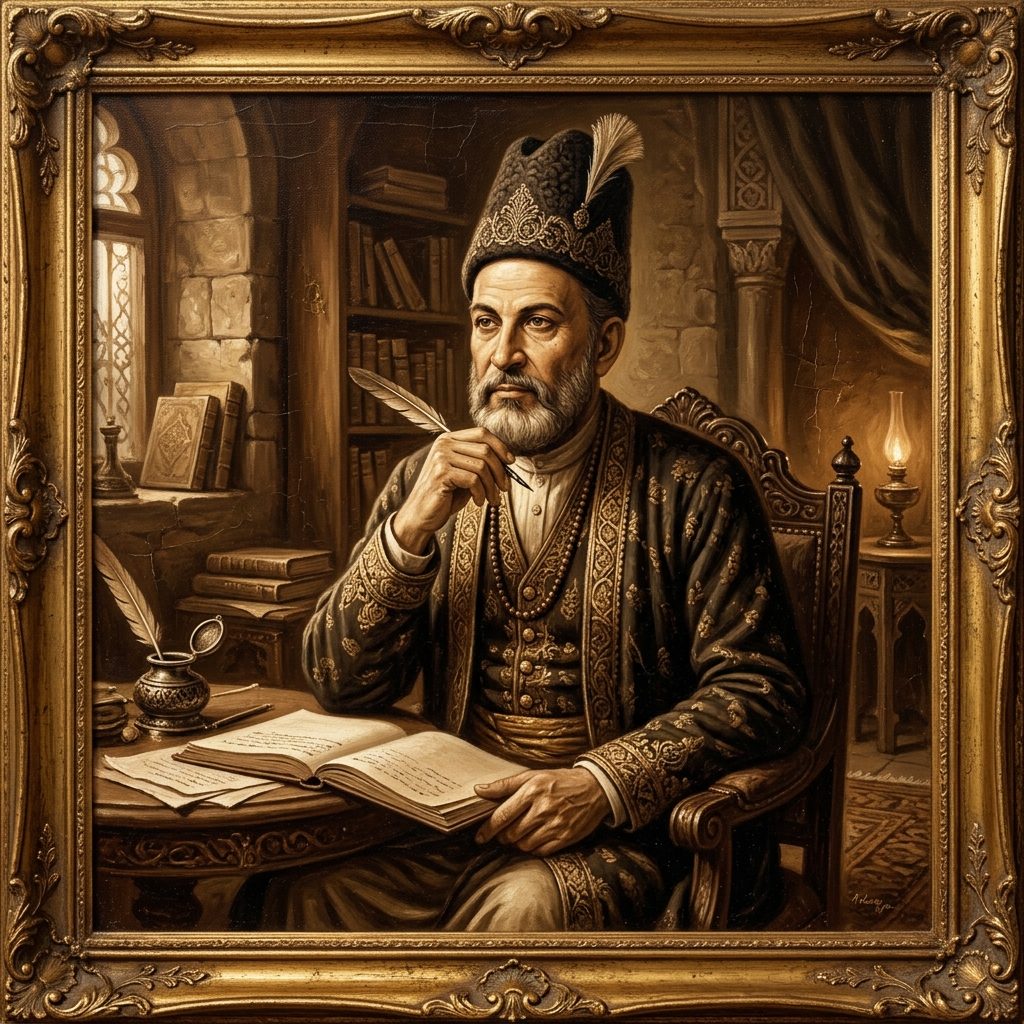
Shan-ul-Haq Haqqee
The dictionary-maker who weighed every word — and found life only after long searching. Shan-ul-Haq Haqqee (1917–2005), born in Delhi on 15 September 1917, was a Pakistani Urdu poet, critic, translator and lexicographer — a scholar who spent his life weighing words, and a poet who weighed them too. His father, Ehtashamuddin Haqqee, wrote short stories and verse translations, and had helped the elder lexicographer Maulvi Abdul Haq compile the great Lughat-i-Kabeer, so the dictionary was the family trade. Haqqee took his BA from Aligarh Muslim University and a master's degree in English literature from St. Stephen's College, Delhi, where he recited his first ghazal at the college's annual gathering. He knew many languages, among them Sanskrit. After Partition he settled in Pakistan, working as a journalist and broadcaster. From 1958 to 1975 he served the Urdu Dictionary Board for seventeen years on its great multi-volume dictionary, a labour he held dear above all his other work, and beside it he compiled two dictionaries of his own: Farhang-e-Talaffuz, a pronouncing dictionary of Urdu, and the Oxford English-Urdu Dictionary. His verse collections were Taar-i-Pairahan (1957) and Harf-i-Dilras (1979), with a selected volume of ghazals, Dil ki Zaban, following later. His prose ranged widely — literary criticism in Naqd-o-Nigarish, short stories, children's verse, and translations that carried the Bhagavad Gita, Shakespeare's Antony and Cleopatra and the Arthashastra into Urdu. He also wrote his autobiography, serialised in the journal Afkaar. Pakistan honoured him with the Sitara-e-Imtiaz and the Tamgha-e-Quaid-e-Azam. His wife, the teacher Salma Haqqee, had died two years earlier. He died of lung cancer at Mississauga, Ontario, Canada, on 11 October 2005, in his daughter's care.
Follow Shan-ul-Haq Haqqee
0 FollowersReceive instant email alerts whenever new Ghazals, Nazms, or Couplets by Shan-ul-Haq Haqqee are published.