
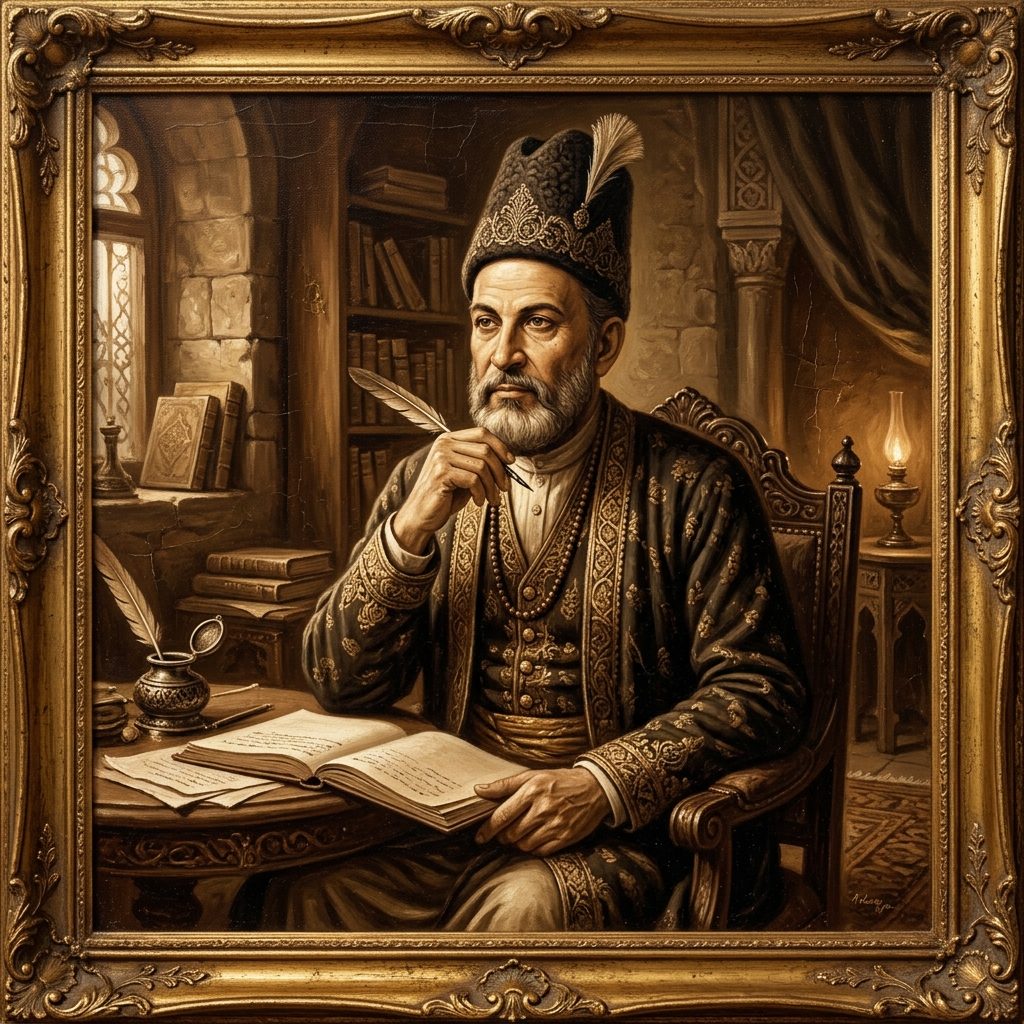
Shaykh Muhammad Ali Hazin Lahiji
The exile of Isfahan — the Persian master who called his life in India a kind of death. Shaykh Muhammad Ali Hazin Lahiji (January 1692–1766) was a Persian poet, memoirist and scholar whose life was broken in two by the fall of a dynasty. Born in Isfahan in January 1692, into a family of scholars and landowners from Lahijan in Gilan, he claimed descent from Shaykh Zahid Gilani, the guide of the house that became the Safavid rulers of Iran. He was schooled in the learning of his day and wrote a fine hand in several scripts. In 1722 the Afghans besieged Isfahan; his younger brothers, his family and many of his friends perished, and the Safavid world he had grown up in fell apart. He spent the next twelve years wandering — through the cities of Iran, the shrine cities of Iraq, and the Hejaz, where he performed the pilgrimage — before making his way to India in 1734, through Sindh, Multan and Lahore, to Delhi. There he was received at the court of Muhammad Shah, but he was a difficult guest: he mocked the king and the court, and scorned the land, its people and the Persian of its poets, and his fiercest opponent was the great scholar Siraj-ud-Din Ali Khan Arzu, whose taste would shape the young Urdu poetry of Delhi. He set down his life in the memoir completed at Delhi in 1741–42, gathered his divan in 1743, and in 1752 compiled his biographical dictionary of the poets. He compiled four divans of verse, of which only one survives. In 1748 he left Delhi for Benares, where he lived the last eighteen years of his life and died in 1766. He was remembered there as a Sufi, and his tomb is venerated to this day. His verse is the poetry of exile: India, for him, was a kind of death, and home was lost for ever with the fall of Isfahan. A century later, Ghalib still counted him among the great masters of Persian poetry.
Follow Shaykh Muhammad Ali Hazin Lahiji
0 FollowersReceive instant email alerts whenever new Ghazals, Nazms, or Couplets by Shaykh Muhammad Ali Hazin Lahiji are published.