Poets Directory (شعرائے کرام)
Explore profiles, portraits, life biographies, and complete poetry of classical and modern Urdu luminaries.
Maharaja Sir Kishan Prasad Shad (1864 – 13 May 1940) of Hyderabad was a poet first and a prime minister second — or, as Hyderabad liked to say, a poet who happened to rule. A childhood friend of Nizam Mahbub Ali Khan and heir to a family that traced itself to Raja Todar Mal, he became Peshkar of Hyderabad State in 1892 and its Dewan (Prime Minister) in 1901, taking the title Yamin-us-Saltanat, "right hand of the realm", and the rank of Maharaja. In his first tenure he raised the state's revenues, organised relief after the great Musi Flood of 1908, and left the treasury fuller than he found it; after resigning in 1912 he was called back by Nizam Osman Ali Khan in November 1926 and served until March 1937, passing the Mulki regulations that reserved posts for Hyderabad's own people. He was knighted KCIE in 1903 and GCIE in 1910. Through all of it he remained a disciple of Dagh Dehlvi, writing Urdu and Persian poetry under the takhallus "Shad" — happy — in a Sufi key: ghazal, naat and marsiya, collected in Bagh-e-Shad (1890) and later volumes, and shared in his own magazine Mahbub al-Kalam. His house was a morning court of poets, painters and musicians from across India, Persia and Arabia, and his life — seven wives, Hindu and Muslim, each following her own faith — was itself an argument for the Ganga-Jamuni tehzeeb he championed. At his death in Hyderabad on 13 May 1940, the Nizam said society had witnessed "the departure of the last vestige of the Mughal Empire".
Majeed Amjad
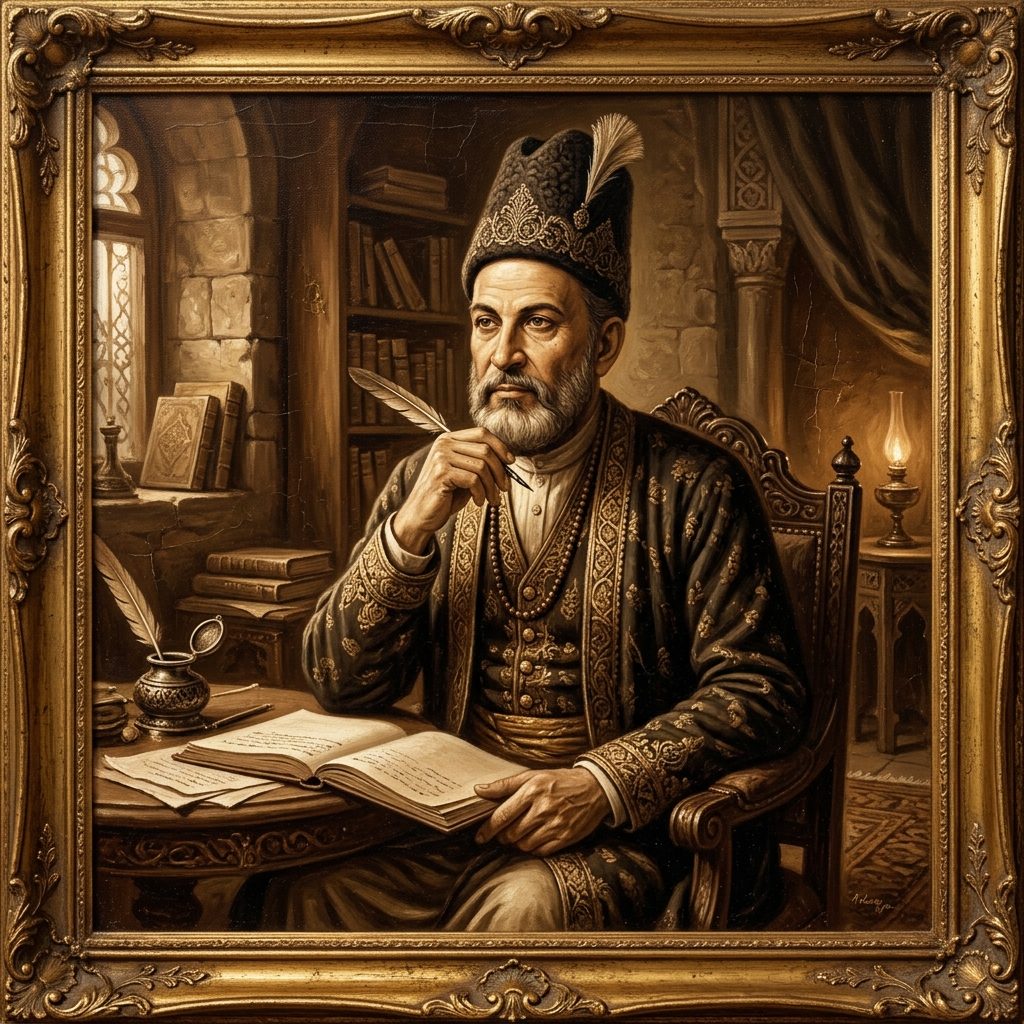
Majeed Amjad (1914–1974) was a Pakistani modern Urdu poet, counted among the founding fathers of modern Urdu poetry and described as a philosophical poet of depth and sensitivity. Born Abdul Majid on 29 June 1914 in Jhang, Punjab, he was taught Arabic and Persian by his maternal grandfather, took his bachelor's degree from Islamia College Lahore in 1934, and edited the weekly Arooj in Jhang. He then served in the Food Department, spending the last twenty-eight years of his life in Sahiwal, where he retired as Assistant Food Controller in 1972 and died on 11 May 1974; he was buried in Jhang. His first collection, Shab-e-Rafta (1958), with a preface in verse, was the only book published in his lifetime; Shab-e-Rafta Ke Baad followed posthumously in 1976, and his complete works, Kuliyat-e-Majeed Amjad, were edited by Khawaja Muhammad Zakariya in 1989. Away from the great literary centres, he built a poetry of striking images and unexpected connections — philosophical, introspective, and deeply personal, in ghazal, nazm and free verse.
Majrooh Sultanpuri
Majrooh Sultanpuri (1919–2000), born Asrar ul Hassan Khan in Sultanpur, U.P., was a Progressive Urdu poet and one of Hindi cinema's most celebrated lyricists. A trained Unani physician (Hakim) and disciple of Jigar Moradabadi, he left medicine for poetry, joined films in 1946 with Shahjahan ("Jab dil hi toot gaya"), and served two years in prison in 1949 for his leftist verse. Across six decades he wrote more than two thousand film lyrics — from Andaz and Dosti ("Chahunga main tujhe sanjh savere", Filmfare Best Lyricist 1965) to Qayamat Se Qayamat Tak and Jo Jeeta Wohi Sikandar ("Pehla nasha") — while his fifty-odd ghazals and two notable nazms carried the Progressive fire; none is more famous than "main akela hi chala tha jaanib-e-manzil magar", which Wikipedia's own article calls one of the best-known verses of Urdu poetry. He became the first lyricist to receive the Dadasaheb Phalke Award (1993), and also received the Ghalib Prize and the Iqbal Samman. He died in Mumbai on 24 May 2000.
Makhdoom Mohiuddin
Makhdoom Mohiuddin (1908–1969), born Abu Sayed Muhammad Makhdoom Mohiuddin in Andole village, Medak district, Hyderabad State, was the revolutionary Urdu poet known as "Shayar-e-Inquilab" (Poet of the Revolution). He founded the Progressive Writers Union in Hyderabad, taught Urdu literature at City College (1934), joined the Communist Party of India, and stood at the forefront of the 1946–47 Telangana Rebellion against the Nizam; he later became a founder of the CPI in Andhra Pradesh, a member of the Andhra Pradesh Legislative Council (1956–1969) and its opposition leader. His collections *Surkh Savera* (1944) and *Gul-e-Tar* (1961) were gathered with the rest of his verse in *Bisat-e-Raqs*, which won the 1969 Sahitya Akademi Award for Urdu. His ghazals — "Aap Ki Yaad Aati Rahi Raat Bhar," "Phir Chhidi Raat, Baat Phoolon Ki," "Ek Chameli Ke Mandve Taley" — became immortal through Hindi films. He died in Hyderabad on 25 August 1969.
Makhmoor Saeedi
Tonk's wandering bird — he still believes the promise, though he has tested it a thousand times. Makhmoor Saeedi (1938–2010), born Sultan Mohammad Khan on 31 December 1938 at Tonk in Rajasthan, was an Indian Urdu poet, critic, translator and journalist, and one of the finest modern voices to come out of Tonk. His father, Ahmed Khan Nazish, was himself a noted Urdu poet. Schooled at Tonk and then at Agra, he moved to Delhi after graduation and gave his life to Urdu letters — writing ghazals and nazms, rubai, qataa, doha and geet, and working in criticism, journalism and translation, including a verse rendering of the Bhagavad Gita into Urdu. His poetry collections include Sabrang, Siyah bar Safed, Awaaz ka Jism (1972), Guftani, Baans ke Jangalon se Guzarti Hawa (1983), Diwaar-o-Dar ke Darmiyan (1994), Umr-e-Guzishta ka Hisab in two volumes, and Raasta aur Main (2003). He was long associated with the Delhi magazine Tahrik, and his work won the Sahitya Akademi Award. He died on 2 March 2010 at Jaipur, aged 71, and was buried at Tonk.
Maulvi Abdul Haq
Maulvi Abdul Haq (1870–1961), remembered as Baba-e-Urdu, the Father of Urdu, gave his whole life to the language — its words, its grammar, its history and its honour. Born on 20 April 1870 at Hapur, he was educated in the Punjab and at Aligarh, where he took his bachelor's degree in 1894, and fell under the influence of Sir Syed, Shibli and Hali. In 1895 he went to Hyderabad, where he taught, edited journals, headed the institute that translated history, science and philosophy into Urdu, and became the first head of the Urdu department at Osmania University. In 1912 he became general secretary of the Anjuman Taraqqi-e-Urdu, the society for the progress of Urdu, and held that post until Partition. He edited the journal Urdu for more than three decades, gathered old manuscripts that rewrote the early history of the language, and produced some fifty volumes — among them his Standard English-Urdu Dictionary and his Urdu grammar — while pressing, all his life, for Urdu to be given its rightful place in public life. After migrating to Pakistan in 1948, he rebuilt the Anjuman in Karachi, founded the Urdu College there, and worked on until illness overtook him. He died at Karachi on 16 August 1961, leaving the language he had served with a dictionary, a grammar, a history — and a father's name.
Maulvi Nazir Ahmad Dehlvi
Delhi's deputy who taught a nation to read — the pioneer of the Urdu novel. Maulvi Nazir Ahmad Dehlvi (1830–1912), known as Deputy Nazir Ahmad, was the pioneer of the Urdu novel — a novelist, reformer, scholar and translator. Born at Rehar in the Bijnor district in 1830, to a family of scholars, he was taught Persian and Arabic by his father, a teacher, and in 1842 was sent to study in Delhi, entering Delhi College in 1846. He began as a teacher of Arabic, became a deputy inspector of schools in 1856, and rose to deputy collector in the North-Western Provinces — the post that gave him his familiar name. His novel Mirat-ul-Uroos (1869), the story of two sisters, Asghari and Akbari, written for the education of girls, established the Urdu novel and has never been out of print; Banat-un-Nash, Taubat-un-Nasuh (1873), Fasana-e-Mubtala (1885), Ibn-ul-Waqt (1888) and Ruya-e-Sadiqa followed. A friend and sometime critic of Sir Syed Ahmad Khan and the Aligarh movement, he wrote more than thirty books, translated the Quran into Urdu, and put the Indian Penal Code into Urdu as Taazirat-e-Hind. He died of a stroke at Delhi on 3 May 1912.
Meeraji
The bohemian who freed the Urdu nazm — symbolism, free verse, and Hindu myth in a life lived by the tavern's edge. Meeraji (1912–1949), born Muhammad Sanaullah Dar into a Kashmiri family of Gujranwala, was one of the founding fathers of the modern Urdu nazm — the pioneer who carried symbolism and free verse into Urdu poetry. Raised in Lahore, he first wrote under the takhallus "Sasri"; a one-sided love for a Bengali girl, Meera Sen, gave him the pen name by which he is remembered. Though brought up in comfort — his father Munshi Mohammad Mahtabuddin was a railway engineer — he left home and family to live as a bohemian wanderer, staying with friends and making a living by selling his songs. He served as poetry editor of the Lahore magazine *Adabi Duniya* (1938), worked for All India Radio in Delhi, wrote literary columns for the monthly *Saqi*, and briefly helped edit *Khayal* in Bombay, settling in Bombay after Partition. Drawn from his teens to Hindu mythology, he wove Hindi vocabulary into his poetry, prose, and letters; he acknowledged his debts to the Sanskrit poet Amaru and the French Baudelaire, and translated Damodar Gupta and Omar Khayyam. His collections include *Meeraji ke Geet*, *Meeraji ki Nazmein*, *Geet hi Geet*, *Paband Nazmein*, and *Teen Rang*; the *Kulliyat-e-Meeraji* appeared in 1988. He died in Bombay in November 1949, aged only thirty-seven.
Mirza Muhammad Hadi Ruswa
Mirza Muhammad Hadi Ruswa (1857–1931), born in Lucknow in the year of the great uprising, was the Urdu novelist who gave the language its first great novel — and a poet in his own right. His ancestors had come from Persia; his great-grandfather was an adjutant in the Nawab of Awadh's army, and the family lane in Lucknow was still called Adjutant's Lane. Educated at Thomson Engineering School (Thomason College, Roorkee), he taught at Lucknow's Central High School and Christian College, worked as a civil servant and railwayman, and later moved to Hyderabad to work at the Dar-ut-Tarjuma, Osmania University's translation bureau. He knew Urdu, Persian, Arabic, Hebrew, English, Latin and Greek, wrote on religion, philosophy and astronomy, and even invented a system of Urdu shorthand. His literary career began in 1887 with a verse Laila-Majnu; then came the novels — Afshai Raz, Zaat-e-Shareef, Shareef Zada, Akhtari Begum — and, above all, Umrao Jan Ada (first published Lucknow, 1899; often cited as 1905), the courtesan-poet's life story told as memoir, regarded by many as the first Urdu novel and later filmed in Pakistan and India. His ghazals — 31 sher catalogued on Rekhta — carry the same world as the novel: two ruined cities, a lifetime's weariness, love as affliction. He died at Hyderabad on 21 October 1931.
Mohammad Ali Jauhar
Mohammad Ali Jauhar (1878–1931) was an Indian Muslim leader, journalist, scholar and Urdu poet, a leading figure of the Khilafat Movement. Born on 10 December 1878 at Rampur, he studied at Aligarh and at Lincoln College, Oxford, then served the Rampur state and the Baroda civil service before turning to journalism — founding the English weekly The Comrade in 1911 and the Urdu daily Hamdard in 1913. He co-founded the All-India Muslim League and Jamia Millia Islamia, led the Khilafat delegation to Europe in 1920, was imprisoned for sedition, and presided over the Indian National Congress in 1923. His Urdu poetry, collected in Deewan-e-Jauhar, carries the same fire as his politics: faith, sacrifice and resistance — above all his Karbala couplet, "the killing of Husain was in truth the death of Yazid", quoted for decades. He died of a stroke in London on 4 January 1931, days after the first Round Table Conference, and was buried in Jerusalem as he had wished.