Poets Directory (شعرائے کرام)
Explore profiles, portraits, life biographies, and complete poetry of classical and modern Urdu luminaries.
Sachal Sarmast
Sachal Sarmast (1739–1829) was a Sindhi Sufi saint-poet of Daraza, a small village near Ranipur in Khairpur, Sindh. Born Abdul Wahab Faruqi, into a family that traced its line to the second caliph Umar, he lost his father as a child and was raised by his uncle, Khwaja Abdul Haq, who became his spiritual master. The name his disciples gave him says what he stood for: Sachal, the truthful one, and Sarmast, drunk with God. He lived his whole life at Daraza — born there, teaching there, and dying there at about ninety — and his shrine still stands in the village, where a three-day gathering is held every year in the month of Ramadan. He is remembered as the poet of seven languages — Sindhi, Saraiki, Persian, Urdu, Punjabi, Arabic and Balochi — though his most celebrated verse is in Sindhi and Saraiki, above all the kafi, the sung Sufi lyric. His poetry sings the unity of being: God is not far away but present in every form, and the lover's cry "I am the Truth" is not defiance but the soul's homecoming. Nine compilations of his Persian verse survive, among them the Diwan-e-Ashkar and the Dard Nama, alongside five Persian masnavis; his collected verse was first printed in 1933.
Sarmad Kashani
Delhi's naked faqir — the Persian mystic of the rubai, martyred for refusing to bend. Sarmad Kashani (c. 1590–1661), whose full name was Muhammad Sa'id, was a Persian-speaking Armenian mystic and poet who made India his home. Born around 1590, in Kashan or Armenia, into a Jewish Persian-speaking Armenian merchant family, he was educated in philosophy and the sacred texts, and studied under the great thinkers of Isfahan. As a wealthy trader he sailed to India and landed at Thatta in Sind in the early 1630s, where he fell in love with a young Hindu, Abhai Chand — a love that turned him from merchant to wandering dervish. The two travelled together through Lahore and Hyderabad to Delhi, where the Mughal crown prince Dara Shikoh welcomed him and became his disciple. Sarmad wrote some three hundred Persian quatrains, the rubaiyat on which his fame rests, with a small number of ghazals and fragments besides; with Abhai Chand he also carried part of the Torah into Persian, and he supplied the account of Judaism in the great comparative survey of religions written in India in his lifetime. He went about Delhi as a naked faqir, owning nothing, speaking plainly against priestcraft and cant, and refusing to bend. After Aurangzeb defeated Dara Shikoh, Sarmad was tried for heresy and beheaded outside the Jama Masjid in Delhi in 1661. His tomb still stands beside the mosque, a place of pilgrimage, and he is remembered as the second Hallaj — the martyr who would not unsay what he believed.
Shah Abdul Aziz Dehlvi
Shah Abdul Aziz Dehlvi (1746–1824), eldest son of Shah Waliullah, was born in Delhi on 11 October 1746 and was seventeen when his father died. He took his father's place as teacher of hadith at the Madrasa Rahimiyya and held it for more than sixty years, becoming the Muhaddith of Delhi — the scholar to whom the whole subcontinent turned on questions of law and tradition. He had memorised the Quran as a boy and mastered the religious sciences young, learning first from his father and then from his father's students. His books number in the dozens: the Persian commentary Fath al-Aziz, dictated to a student while he was ill; the collection of legal opinions known as Fatawa-e-Azizi; Bustan al-Muhaddithin, a garden of the hadith masters; and Tuhfa Ithna Ashariya, his reasoned answer to Twelver Shiism, published in 1789. His most lasting gift to ordinary readers was the Quran in Urdu — he translated the whole Book into the language of the people and completed his father's Persian commentary where it had stopped. After British rule settled over India he issued the ruling that the land was a territory under non-Muslim rule, a judgement that stirred the religious movements of the century after him. He died in Delhi on 5 June 1824 and lies beside his father in the Mehdiyan cemetery.
Shah Abdul Latif Bhittai
Shah Abdul Latif Bhittai (1689–1752) is the greatest poet of the Sindhi language — a Sufi saint of Sindh whose verse was sung before it was ever written down. Born at Hala Haveli to Shah Habib, of a family tracing its line to Herat, he left home young and wandered Sindh, Punjab and the Thar desert, learning from mystics and Jogis, before settling at the mound of Bhit — the "Bhittai", the man of the mound — where his shrine stands today. His disciples gathered his sung verses after his death into Shah Jo Risalo, thirty chapters set to the ragas, in which the folk heroines of Sindh — Sassui, Sohni, Marui, Momal, Noori, Sorath and Lila — become figures of the soul's search for the Beloved. He also wrote in Persian, and his message was simple and wide: one God, love of the Prophet, tolerance, and the dignity of every human being.
Shah Abdul Qadir Dehlvi
Shah Abdul Qadir Dehlvi (1753–1815), third son of Shah Waliullah, was born in Delhi in 1753 and was nine years old when his father died. Much of his education came from his elder brother, Shah Abdul Aziz, at the Madrasa Rahimiyya. His life's work was a single great act of translation: Muzih-ul-Quran, the first complete Urdu rendering of the Quran in living, idiomatic language, finished in 1790–91 and first printed at Delhi in 1829. Where his brother Rafiuddin had translated word by word, Abdul Qadir translated sense by sense, with short notes that opened difficult passages to ordinary readers — so that the Book could be read, at last, in the language of the home. He also wrote a short guide to purification and prayer and left notes on the Quran's meaning. He died in Delhi on 27 June 1815, and his translation has never gone out of use.
Shah Alam II
Shah Alam II (1728–1806), born Mirza Ali Gauhar at Shahjahanabad, Delhi, was the Mughal emperor who reigned from 1759 until his death — a king who kept his throne and lost his empire, and a serious poet who wrote under the pen-name Aftab, "the Sun". Son of Alamgir II, he was crowned a fugitive in Bihar and did not return to Delhi until 1772; in 1788 the Afghan chief Ghulam Qadir blinded him, and he ended his life in Delhi under British protection, still universally regarded as emperor. As his power faded, poetry became his chief pursuit: his Persian and Urdu ghazals, guided and collected by Mirza Fakhir Makin, fill a diwan (Nadirat-e-Shahi, compiled around 1797), and he also wrote Ajaib-ul-Qasas, one of the earliest works of Urdu prose. He composed in Persian and Urdu as Aftab, in Braj Bhasha under his own title "Shah Alam", and knew Arabic, Sanskrit and Turkish besides. He died in Delhi on 19 November 1806.
Shah Hatim
The soldier-poet who gave Delhi its first Urdu impulse — and purified its diction a century before the Lucknow reformers. Shah Hatim (1699–c. 1783), born Shaikh Zahuruddin in Delhi, was a soldier who became one of the founding voices of Urdu poetry in Delhi. When Wali Dakhni's diwan reached the capital around 1720, Hatim and his friends Naji, Mazmun and Abru took up Rekhta poetry — Delhi's answer to the Deccan. By profession a sepoy (he served as an inspector under Nawab Amdat-ul-Mulk of Allahabad and in the households of several nobles), he spent his last days in seclusion near the Delhi Fort. His lasting act was editorial: mid-century he discarded his early diwan and recompiled his work in a purified, standardised Rekhta idiom, naming it *Divan Zadeh* ("Descendant of the Diwan") — the first conscious program of Urdu poetic reform, a century before Nasikh and Aatish are credited with it. Deeply influenced by Khan Arzu (though not formally his disciple), he was proudest of his own pupil: Mirza Muhammad Rafi Sauda. His *Divan Zadeh* holds ghazals, mukhammas, rubais, a saqi-nama, two masnavis in praise of tobacco and qehwa, and a shehr-ashob on Muhammad Shah's Delhi.
Shah Hussain
Shah Hussain (1538–1599) was the pioneer of the Punjabi kafi and the first great poet of early-modern Punjab. He was born in 1538 inside the walled city of Lahore — the same year Guru Nanak died — the son of Sheikh Usman, a weaver of the Dhudha Rajput clan; his grandfather had embraced Islam, and Hussain grew up among the looms, taking the weaver's images — thread, shuttle, cloth — into his verse for the rest of his life. As a young man he became the disciple of Shaikh Bahlol Daryai, founder of a branch of the Qadiri order, and studied until his mid-thirties. Then, at thirty-six, he turned away from formal prayer, put on red clothes, and began to sing and dance in the streets of old Lahore — a faqir by choice, not by birth. It was then that he met Madho Lal, a young Brahmin boy from Shahdara across the Ravi, thirty-eight years his junior; the bond between them became so complete that the two names fused into one, Madho Lal Hussain, and when Hussain died they were buried together at Baghbanpura, near the Shalimar Gardens. His kafis — short poems of four to ten lines, made to be sung — are the first of their kind in Punjabi: simple in language, built on the rhythms of folk song, and carrying a voice that is often a woman's, a weaver's, a sweeper's, never a dignitary's. More than 160 of them survive, passed down by singers until the oldest manuscript was written in 1804, and they are still sung today. He died in 1599, at sixty-one, near the Ravi, and every year his shrine fills with light for the Mela Chiraghan, the Festival of Lights — Lahore still keeps the feast of its red-clad saint.
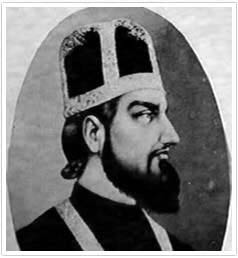
Shah Mubarak Abro (birth year disputed — 1683 or 1685, Gwalior; died 1733, Delhi) is one of the founding fathers of Urdu poetry. A grandson of the saint Muhammad Ghaus Gwaliori, he came to Delhi as a young man and became a disciple of the great scholar-poet Siraj-ud-Din Ali Khan Arzu — in whose circle the young Khwaja Mir Dard also studied. Abroo's place in history rests on a surviving fact: his Diwan-e-Abroo endures, making him the first authenticated sahib-e-diwan — master of a collected divan — of Rekhta in northern India. His art was iham, the double meaning: a single line that says two things at once, witty, idiomatic, rooted in Hindustani and Braj speech rather than Persian loftiness. He pioneered a whole genre on the grace of an imaginary beloved — love addressed to a beauty who never existed, and all the truer for it. He died in Delhi in 1733 — one tazkira says, kicked by a horse — and lies near Syed Hasan Rasul Numa. Where he stands in the line is clear: the generation that taught Urdu to smile and to mean two things at once.
Shah Nasir
Shah Nasir (1756–1838) — also spelled Shah Naseer — was a prominent poet and Sufi of 18th-century Delhi. Born Mohammad Naseeruddin, known as Mian Kallu, he succeeded his father as Sajjada Nashin of the family dargah in 1768, and learned his craft as the pupil of Shah Mohammad Mail, a disciple of Qayem Chandpuri, in the company of Khwaja Mir Dard. He travelled to Meerut and Lucknow, meeting Jur'at, Mushafi, Aatish and Nasikh, and became master guide to members of the royal family. He was a trend-setter of his age, famed for complicated metres and difficult radifs — and the teacher of the next generation: Momin, Zauq and Zafar were his pupils. His ghazal holds the Sufi and the lover in one voice: the beloved's name as rosary and meditation, the mosque and the temple both set aside, and the heart's pain measured out in proverbs. 71 of his ghazals and 97 of his sher survive.