Poets Directory (شعرائے کرام)
Explore profiles, portraits, life biographies, and complete poetry of classical and modern Urdu luminaries.
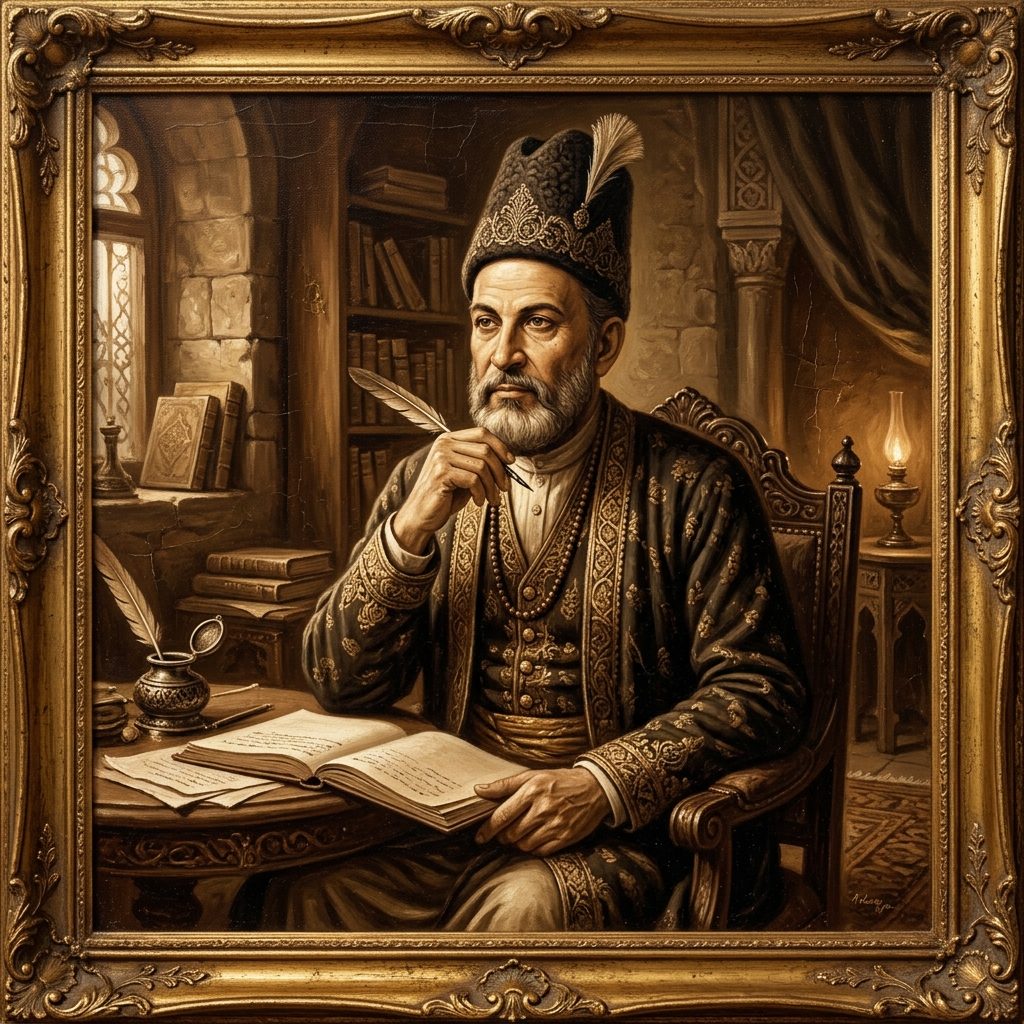
Muhammad Husain Azad
Muhammad Husain Azad (1830–1910), born in Delhi on 5 May 1830 into a Persian immigrant family, was the stylist who remade Urdu prose and the critic who wrote its first great literary history. His mother died when he was four; his father, Maulvi Muhammad Baqir, educated at Delhi College, bought a press in 1837 and launched the Delhi Urdu Akhbar — probably the first Urdu newspaper in northern India. Azad graduated from Delhi College in 1854 and joined his father's paper — until 1857, when the paper's support for the uprising cost his father his life: Baqir was executed by the British, and the whole joint family was thrown out of its house. After years of hardship and hiding, Azad migrated to Lahore in 1861, worked at the General Post Office and the Director of Public Instruction's office, and found his place when the Anjuman-e-Punjab was founded: lecturer in 1866, its secretary in 1867, then professor of Urdu and Persian at Government College, Lahore. In 1887 he founded the Azad Library and received the title Shams-ul-Ulama, Sun among the Learned. His Aab-e-Hayat (1880) — lives of Urdu poets and the story of the language itself — remains the foundation stone of Urdu literary history; around it stand Qisas-ul-Hind, Nairang-e-Khiyal, Sukhandan-e-Fars and Darbar-e-Akbari. As a poet he was the pioneer of the new natural nazm, writing on nature and everyday subjects instead of only rose and nightingale, beginning with "Shab-e-Qadr." He died at Lahore on 22 January 1910.
Muhammad Nusrati
Muhammad Nusrati (d. 1674) was a seventeenth-century Dakhni poet of the Adil Shahi court at Bijapur, where he rose to poet laureate. Born in the Carnatic region, he lived for a time as a Sufi dervish before coming to Bijapur, where he became a mansabdar under Sultan Ali Adil Shah II and was named malik al-shu'ara, king of poets, for his 'Ali-nama. That masnavi, patterned on the Persian Shah-nama, celebrates Ali II's wars against the Mughals and Marathas and is the earliest panegyric of a ruler in Dakhni. His earlier romance masnavi Gulshan-i 'Ishq (1657/1658) follows Prince Manohar's quest for Madhumalati to their union in a rose garden. His final poem, Tarikh-i Sikandari, celebrates Bahlol Khan's victory over Shivaji at Umrani in 1672. Writing in archaic, complex Dakhni, Nusrati is remembered as Bijapur's greatest poet, and as a theorist who first separated a poem's theme (mazmun) from its deeper meaning (ma'ni).
Muhammad Quli Qutb Shah
Muhammad Quli Qutb Shah (1565–1612), the fifth Sultan of Golconda, is remembered by history as a king — and by Urdu as its first true poet. Ascending the throne at fifteen in 1580, he ruled thirty-one years, and in 1591 founded a new capital on the south bank of the Musi: Hyderabad, crowned by the Charminar and the Mecca Masjid. But his deeper founding was literary. He is the first *sahib-e-diwan* of Urdu — the first to compile a full diwan of Urdu verse, the *Kulliyat-e-Quli Qutb Shah*, writing in the Dakhni idiom of the Deccan alongside Persian and Telugu. His court made Dakhni a language of poetry, celebration, and devotion: ghazals, qasidas, masnavis, marsiyas, hamds and manqabats, in an earthy, musical diction full of "na" for "nahin" and "koon" for "ko". He is a Shi'a poet of divine and earthly love alike, and he is called the father of Urdu poetry in India. His famous munajat — "mera shahar logan sun ma'mur kar" (populate my city with people) — is still remembered as the prayer with which Hyderabad was born. He died in Hyderabad on 11 January 1612.
Mulla Wajhi
The Deccan's first classic — the masnavi and prose tale that gave Urdu its southern beginning. Mulla Wajhi (real name Asadullah; birth year not known — died about 1665–1672, Golconda, Deccan) was the first great poet of the Deccan and the founder of Urdu poetry and prose in the south. Born in Golconda during the reign of Sultan Ibrahim Qutb Shah, from a family said to have come from Khurasan, he rose to become the first poet laureate of the Golconda court under Muhammad Quli Qutb Shah. In 1609 he wrote Qutb Mushtari, a romance in verse telling the love of Prince Qutb Shah for the princess Mushtari, a work counted among the first long poems in Urdu. After the king's death he fell from favour, and lived in hardship and obscurity under the pious Muhammad Qutb Shah, until Abdullah Qutb Shah recalled him to honour. At the sultan's command he wrote Sab Ras in 1634, a prose allegory of love in which a prince's search for his beloved becomes a teaching on conduct and the life of the spirit — the first great work of Urdu prose. He also wrote Taj-ul-Haqaiq, and marsiyas for the mourning gatherings of his time, one of which, on Husain, was long sung. His verse and prose gave the language of the Deccan its first classics, and for some two and a half centuries after him his books were loved and read across the Deccan.
Munawwar Rana
Munawwar Rana was an Indian Urdu poet who brought the mother into the centre of the ghazal, a form long reserved for the beloved. Born in Raebareli, Uttar Pradesh, and long associated with Kolkata and later Lucknow, he wrote in plain Hindi-Urdu mixed with Awadhi, deliberately avoiding heavy Persian and Arabic vocabulary so ordinary listeners could follow him at mushairas. His best-known work, Maa, and collections including Shahdaba, for which he won the Sahitya Akademi Award in 2014, celebrate mothers, daughters, labourers, migrants and home. He returned the Akademi award in 2015 in protest against rising intolerance. He died in Lucknow on 14 January 2024, aged 71.
Munir Niazi
Munir Niazi (1923–2006), born Munir Ahmad at Khanpur, Hoshiarpur district, Punjab (British India), was one of the most distinctive voices of modern Urdu and Punjabi poetry. His early schooling was at Khanpur; after Partition in 1947 his family migrated to Sahiwal, where he passed his matriculation and met the noted poet Majeed Amjad, who became his mentor and friend. He earned an intermediate degree from Sadiq Egerton College, Bahawalpur, and a B.A. from Dayal Singh College, Lahore. In 1949 he launched the weekly Seven Colours from Sahiwal; in 1960 he established the publication institute Al-Misal; he was later associated with Pakistan Television, Lahore. In the 1960s his film songs became super-hits — "Us bewafa ka shehr hai aur hum hain dosto" (Shaheed, 1962) made him one of the foremost movie songwriters of Pakistan. He published thirteen Urdu collections — including Taiz Hawa Aur Tanha Phool, Jungle Mein Dhanak, Dushmanon Ke Darmiyan Shaam and Mah-e-Munir — and three in Punjabi: Safar di Raat, Char Chup Cheezan and Rasta Dassan Walay Tarey. He experimented with poetic forms, forging a new imagery, rhythm and diction; innocence, mythology, nostalgia, dreams, melancholy and romance run through his work. He received the Pride of Performance (1992), the Sitara-e-Imtiaz, and the Pakistan Academy of Letters' Kamal-e-Funn Award (2002). He died of respiratory illness in Lahore on 26 December 2006 and rests in Model Town graveyard.
Mustafa Zaidi
Mustafa Zaidi (died 12 October 1970) was a Progressive Urdu poet whose life ended as mysteriously as some of his verse. Born in Allahabad — his birth year is disputed, 1929 against 1930, and is recorded here as Unknown — he was educated there (Modern High School; Ewing Christian College; BA, University of Allahabad, first class), migrated to Pakistan in 1951, and took an MA in English Literature from Government College Lahore (1953). He joined the Civil Service of Pakistan in 1954, served as deputy commissioner and deputy secretary, and was dismissed in June 1970 with 38 other CSP officers under Yahya Khan. He married Vera Zaidi, a German national, and had a son and a daughter. His first book, *Zanjeeren / Roshni*, published when he was 19, was endorsed by Josh Malihabadi and Firaq Gorakhpuri; later books include *Shehr-e-Azar, Qaba-e-Saz, Mauj Meri Sadaf Sadaf, Koh-e-Nida* and *Gareban*, and he received the Tamgha-e-Quaid-e-Azam. His style is poignant, modern and socially aware. On 12 October 1970 he was found dead in Karachi in circumstances never settled — suicide or murder — and lies in Karachi's Wadi-e-Hussain cemetery.
Muztar Khairabadi
Muztar Khairabadi (1865–1927) was a distinguished Urdu poet of the classical tradition, born in Khairabad into a family steeped in scholarship and poetry. His grandfather was the scholar-poet Fazl-e-Haq Khairabadi, and his first teacher in poetry was his mother, herself a learned poet in Urdu, Persian and Arabic. After her death he sent work to Ameer Minai, who returned it saying it needed no correction. Muztar served in the princely states of Tonk and Rampur and spent much of his life in Gwalior, receiving the titles Eitbar-ul-Mulk and Iftikhar-ul-Shaura. He wrote ghazals, marsiyas, naats and long narrative poems, including Nazr-e-Khuda, Milaad-e-Mustafa and Behr-e-Taweel, and edited the literary magazine Karishma-e-Dilbar. Much of his work was later lost; a five-volume collection, Kharman, was published from his surviving papers. He was the father of poet-lyricist Jan Nisar Akhtar and grandfather of Javed Akhtar.
Nasreen Anjum Bhatti
Nasreen Anjum Bhatti (birth year unknown–2016) was a Pakistani poet, painter, broadcaster and rights activist, born in Quetta and raised in Jacobabad, Sindh. She took her M.A. in Urdu from Oriental College, Lahore, in 1970 and joined Radio Pakistan in 1971, where she served as producer, broadcaster and deputy controller, later becoming resident director of the Shakir Ali Museum in Lahore. Writing in both Punjabi and Urdu, she was a feminist voice of resistance — against General Zia's martial law and against patriarchy. Her first Punjabi collection, *Neel Karaiyan Neelkan* (1979), contains the long poem "Bhutto di Vaar" on Zulfikar Ali Bhutto's hanging; *Athay Pehr Tarah* (2009) followed, with the Urdu collections *Bin Bass* and *Tera Lehja Badalne Tak*. She received the Tamgha-i-Imtiaz in 2011 and died of cancer in Karachi in January 2016.
Nawab Mustafa Khan Shefta
Nawab Mustafa Khan Shefta (1809–1869), born in Delhi into a prominent Bangash Pathan landowning family — Nawab of Jahangirabad, holder of the Palwal and Jehangirabad jagirs — was a poet, critic and patron at the heart of Delhi's literary circle, alongside Ghalib, Zauq and Momin. He wrote Urdu verse as "Shefta" and Persian verse as "Hasrati," consulting Ghalib in Persian and Momin in Urdu, and his Delhi house was famous for its weekly mushairas, where he encouraged younger poets — it was Shefta who introduced Altaf Hussain Hali to Ghalib. His tazkira Gulshan-e-Bekhar (compiled 1834), cataloguing 671 poets, remains a trusted source for the literary history of the age. The 1857 uprising broke his world: suspected for his ties to Bahadur Shah Zafar and his rebel kinsmen, he was sentenced to seven years' imprisonment, his estates seized — half restored on appeal — and much of his poetry was lost in the sack of Delhi. His son later bought the very prison and built the family home, Mustafa Castle, over it, keeping the prison room. After the Hajj he turned increasingly to religious practice. He died at his house in Kucha Chelaan, Delhi, in 1869, and lies in the Bangash family graveyard at Hazrat Nizamuddin, near Ghalib.