Poets Directory (شعرائے کرام)
Explore profiles, portraits, life biographies, and complete poetry of classical and modern Urdu luminaries.
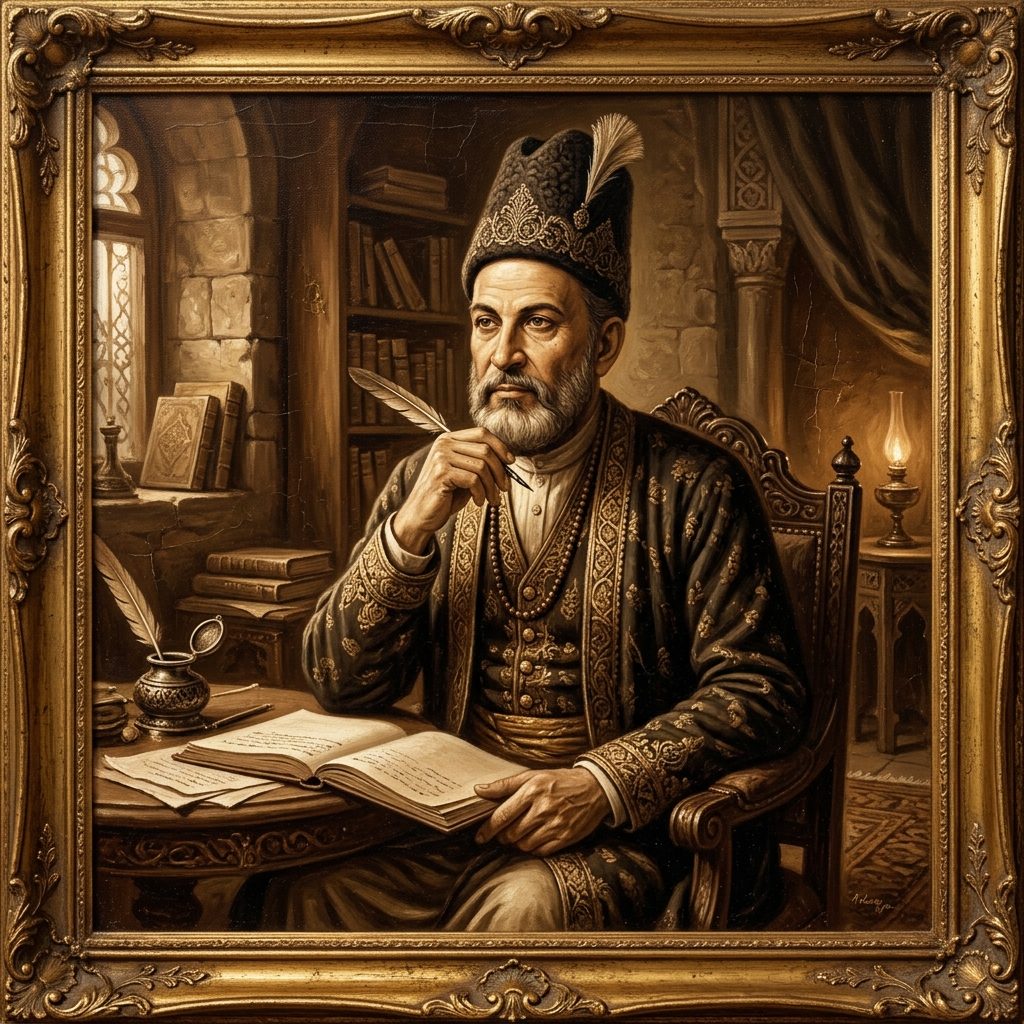
Mohsin Naqvi
Mohsin Naqvi (1947–1996), born Syed Ghulam Abbas Naqvi in 1947 at the village of Sadat near Dera Ghazi Khan, Punjab, was the voice in which modern Urdu grief learned to speak plainly — and the poet Pakistan calls the "Shayar-e-Ahl-e-Bayt". His father, Syed Chirag Hussain Shah, was a saddlemaker and food vendor; Mohsin graduated from Government College, Bosan Road, Multan, and took his master's degree from the University of the Punjab, Lahore, where he was already known by his pen name. His ghazals — collected in Azaab-e-Deed, Khaima-e-Jaan, Barg-e-Sehra, Band-e-Qaba and others — move between romantic longing and Karbala: love's separation and Husain's grief are, in his verse, two faces of one devotion, which is why his lines are recited as readily in majalis as in mushairas. He wrote with a direct, unadorned diction that made him beloved far beyond literary circles, and he did not spare the rulers of his day. On 15 January 1996 he was assassinated in Lahore, near Moon Market; he was buried at Dera Ghazi Khan, mourned by thousands.
Moin Ahsan Jazbi
Moin Ahsan Jazbi was an Indian Urdu poet and a major voice of the Progressive Writers' Movement who struck a different chord with it — representing the classical literary tradition and blending it with contemporary poetics. Born on 21 August 1912 at Mubarakpur in Azamgarh district, he began composing poetry at the age of nine, sought guidance from Hamid Shahjehanpuri, and first used the takhallus Malaal before becoming Jazbi. He took his B.A. from Anglo-Arabic College, Delhi (1932), his M.A. in Urdu from Aligarh Muslim University (1934), and his Ph.D. in 1938 on Hali's political consciousness, published as Hali Ka Siyasi Shuoor (1959). After working as assistant editor of the Urdu monthly Aajkal, he joined Aligarh's Urdu department in 1945 and retired as Reader in 1974. His collections are Firozaan (1951), Sukhan-e-Mukhtasar (1960) and Gudaaz-e-Shab (1985); his ghazal 'Marne ki duaen kyun maangun…' became widely sung. He received the Ghalib Award in 1975 and died on 13 February 2005.
Mufti Muhammad Sadruddin Khan Azurda
Mufti Muhammad Sadruddin Khan Azurda (1804–1868) of Delhi was, at once, the city's Grand Mufti, one of its leading scholars of hadith and Islamic law, and a poet of the Delhi school. Son of Lutfullah, he studied under Shah Abdul Aziz — Delhi's great authority on hadith — and Fazl-e-Imam Farooqi Khairabadi, served as Sadr Amin of Delhi from 1827 to 1846, then as Sadr-us-Sudur (Grand Mufti) from 1846 to 1857, and examined Arabic at the Anglo-Oriental College. His Delhi house was a meeting place of rebel leaders, scholars, poets and literary men, and he was an acquaintance and admirer of Ghalib. In 1857 he was one of the thirty Delhi scholars who signed the declaration calling the uprising a jihad; he mediated between the British, the Mughal court and the sepoys, was tried after the fall of Delhi, spent six months in detention, and lost his property — his house was restored through Lord Lawrence's intercession, his library was lost for good. Syed Ahmed Khan counted him an accomplished scholar; Hakim Abdul Hai called him the pride of India. He wrote in Persian and Urdu under the takhallus "Azurda" — the distressed one — a name his later years earned twice over. He died in Delhi in 1868.
Muhammad Abdul-Hayy Siddiqui, known as Bekhud Badayuni (17 September 1857 – 10 November 1912), was a leading late-19th- and early-20th-century poet of Badayun, from a prominent Siddiqui family of Islamic scholarship, Sufism and literature, claiming descent from Abu Bakr. Trained as a lawyer — he practised in Moradabad and Shahjahanpur — he later became a high official in the states of Sirohi and Jodhpur. His poetic masters mark his place in the tradition: he was first a disciple of Maulana Altaf Hussain Hali, Ghalib's protégé, who gave him the pen name Bekhud; around 1879, as Hali turned away from traditional forms, he left Hali and became a disciple of Nawab Mirza Khan Daagh Dehlvi. He stayed aloof from the squabble over Daagh's successor, though Daagh is reported to have answered "Bekhud-ain" — the two Bekhuds — when asked: Badayuni and Dehlvi. He published late: his diwan appeared only in 1910, two years before his death, partly to combat the plagiarism and misattribution of verse that had circulated orally for decades — the very confusion that still mixes his work with Bekhud Dehlvi's. His books include Hosh-o-Khirad ki Dukaan (1889), Sabr-o-Shakeeb ki Loot (1889), Marraat-ul-Khayal — Mirror of Thoughts — (1910) and Afsaanah-e-Bekhud. His subjects are love, philosophy, mysticism and Islam.
Muhammad Husain Azad
Muhammad Husain Azad (1830–1910), born in Delhi on 5 May 1830 into a Persian immigrant family, was the stylist who remade Urdu prose and the critic who wrote its first great literary history. His mother died when he was four; his father, Maulvi Muhammad Baqir, educated at Delhi College, bought a press in 1837 and launched the Delhi Urdu Akhbar — probably the first Urdu newspaper in northern India. Azad graduated from Delhi College in 1854 and joined his father's paper — until 1857, when the paper's support for the uprising cost his father his life: Baqir was executed by the British, and the whole joint family was thrown out of its house. After years of hardship and hiding, Azad migrated to Lahore in 1861, worked at the General Post Office and the Director of Public Instruction's office, and found his place when the Anjuman-e-Punjab was founded: lecturer in 1866, its secretary in 1867, then professor of Urdu and Persian at Government College, Lahore. In 1887 he founded the Azad Library and received the title Shams-ul-Ulama, Sun among the Learned. His Aab-e-Hayat (1880) — lives of Urdu poets and the story of the language itself — remains the foundation stone of Urdu literary history; around it stand Qisas-ul-Hind, Nairang-e-Khiyal, Sukhandan-e-Fars and Darbar-e-Akbari. As a poet he was the pioneer of the new natural nazm, writing on nature and everyday subjects instead of only rose and nightingale, beginning with "Shab-e-Qadr." He died at Lahore on 22 January 1910.
Muhammad Nusrati
Muhammad Nusrati (d. 1674) was a seventeenth-century Dakhni poet of the Adil Shahi court at Bijapur, where he rose to poet laureate. Born in the Carnatic region, he lived for a time as a Sufi dervish before coming to Bijapur, where he became a mansabdar under Sultan Ali Adil Shah II and was named malik al-shu'ara, king of poets, for his 'Ali-nama. That masnavi, patterned on the Persian Shah-nama, celebrates Ali II's wars against the Mughals and Marathas and is the earliest panegyric of a ruler in Dakhni. His earlier romance masnavi Gulshan-i 'Ishq (1657/1658) follows Prince Manohar's quest for Madhumalati to their union in a rose garden. His final poem, Tarikh-i Sikandari, celebrates Bahlol Khan's victory over Shivaji at Umrani in 1672. Writing in archaic, complex Dakhni, Nusrati is remembered as Bijapur's greatest poet, and as a theorist who first separated a poem's theme (mazmun) from its deeper meaning (ma'ni).
Muhammad Quli Qutb Shah
Muhammad Quli Qutb Shah (1565–1612), the fifth Sultan of Golconda, is remembered by history as a king — and by Urdu as its first true poet. Ascending the throne at fifteen in 1580, he ruled thirty-one years, and in 1591 founded a new capital on the south bank of the Musi: Hyderabad, crowned by the Charminar and the Mecca Masjid. But his deeper founding was literary. He is the first *sahib-e-diwan* of Urdu — the first to compile a full diwan of Urdu verse, the *Kulliyat-e-Quli Qutb Shah*, writing in the Dakhni idiom of the Deccan alongside Persian and Telugu. His court made Dakhni a language of poetry, celebration, and devotion: ghazals, qasidas, masnavis, marsiyas, hamds and manqabats, in an earthy, musical diction full of "na" for "nahin" and "koon" for "ko". He is a Shi'a poet of divine and earthly love alike, and he is called the father of Urdu poetry in India. His famous munajat — "mera shahar logan sun ma'mur kar" (populate my city with people) — is still remembered as the prayer with which Hyderabad was born. He died in Hyderabad on 11 January 1612.
Mulla Wajhi
The Deccan's first classic — the masnavi and prose tale that gave Urdu its southern beginning. Mulla Wajhi (real name Asadullah; birth year not known — died about 1665–1672, Golconda, Deccan) was the first great poet of the Deccan and the founder of Urdu poetry and prose in the south. Born in Golconda during the reign of Sultan Ibrahim Qutb Shah, from a family said to have come from Khurasan, he rose to become the first poet laureate of the Golconda court under Muhammad Quli Qutb Shah. In 1609 he wrote Qutb Mushtari, a romance in verse telling the love of Prince Qutb Shah for the princess Mushtari, a work counted among the first long poems in Urdu. After the king's death he fell from favour, and lived in hardship and obscurity under the pious Muhammad Qutb Shah, until Abdullah Qutb Shah recalled him to honour. At the sultan's command he wrote Sab Ras in 1634, a prose allegory of love in which a prince's search for his beloved becomes a teaching on conduct and the life of the spirit — the first great work of Urdu prose. He also wrote Taj-ul-Haqaiq, and marsiyas for the mourning gatherings of his time, one of which, on Husain, was long sung. His verse and prose gave the language of the Deccan its first classics, and for some two and a half centuries after him his books were loved and read across the Deccan.
Munawwar Rana
Munawwar Rana was an Indian Urdu poet who brought the mother into the centre of the ghazal, a form long reserved for the beloved. Born in Raebareli, Uttar Pradesh, and long associated with Kolkata and later Lucknow, he wrote in plain Hindi-Urdu mixed with Awadhi, deliberately avoiding heavy Persian and Arabic vocabulary so ordinary listeners could follow him at mushairas. His best-known work, Maa, and collections including Shahdaba, for which he won the Sahitya Akademi Award in 2014, celebrate mothers, daughters, labourers, migrants and home. He returned the Akademi award in 2015 in protest against rising intolerance. He died in Lucknow on 14 January 2024, aged 71.
Munir Niazi
Munir Niazi (1923–2006), born Munir Ahmad at Khanpur, Hoshiarpur district, Punjab (British India), was one of the most distinctive voices of modern Urdu and Punjabi poetry. His early schooling was at Khanpur; after Partition in 1947 his family migrated to Sahiwal, where he passed his matriculation and met the noted poet Majeed Amjad, who became his mentor and friend. He earned an intermediate degree from Sadiq Egerton College, Bahawalpur, and a B.A. from Dayal Singh College, Lahore. In 1949 he launched the weekly Seven Colours from Sahiwal; in 1960 he established the publication institute Al-Misal; he was later associated with Pakistan Television, Lahore. In the 1960s his film songs became super-hits — "Us bewafa ka shehr hai aur hum hain dosto" (Shaheed, 1962) made him one of the foremost movie songwriters of Pakistan. He published thirteen Urdu collections — including Taiz Hawa Aur Tanha Phool, Jungle Mein Dhanak, Dushmanon Ke Darmiyan Shaam and Mah-e-Munir — and three in Punjabi: Safar di Raat, Char Chup Cheezan and Rasta Dassan Walay Tarey. He experimented with poetic forms, forging a new imagery, rhythm and diction; innocence, mythology, nostalgia, dreams, melancholy and romance run through his work. He received the Pride of Performance (1992), the Sitara-e-Imtiaz, and the Pakistan Academy of Letters' Kamal-e-Funn Award (2002). He died of respiratory illness in Lahore on 26 December 2006 and rests in Model Town graveyard.